Christmas Meditations

Full Moon is a research service on technology, business and creativity, from Mark Curtis and David Mattin. If you're reading this and you haven't yet subscribed, then hit the button:
Fellow Lunartiks!
Christmas is fast upon us. Here at Full Moon, we are about to dust off our festive jumpers and go dark for a few days. But first, there is time for one final Ideas newsletter of 2025.
There are Ideas from both of us in this edition. David writes first, on an end of year ritual. Then comes Mark, with meditations on what technology gives us and what it takes away.
Before we dive in, though, one important message to close out the year:
Thanks so much for being among the first subscribers to Full Moon. Your early enthusiasm means a lot. There is a long and exciting road ahead, and we can't wait to travel it with you — and with a growing band of Lunartiks — in 2026.
So much about launching Full Moon has been wonderful. But best of all has been corresponding with many of you about our arrival and launch essay, Where is Design Heading? This place was always intended to be the site of a conversation between us and you; please do keep writing to us.
We'll be back in your inbox on the night of 3rd January: the first full moon of 2026.
In the meantime, wishing you a very Merry Christmas and a fantastic New Year! Now, over to those Ideas.
An End of Year Ritual
(David) I love this time of year. Not only for the Christmas vibes, but because of the cognitive and emotional space it opens. The end of the year means, for me, a chance to take stock of what I've done — and failed to do — across the last 12 months, where I am now, and what lies ahead.
It's long been my habit to write an annual review, which addresses those questions. I've been doing it for years. Some, it's true, are more comprehensive than others. I can see that in the years immediately following the birth of my children, I couldn't spare much time for the Annual Review.
This year, I've had an idea:
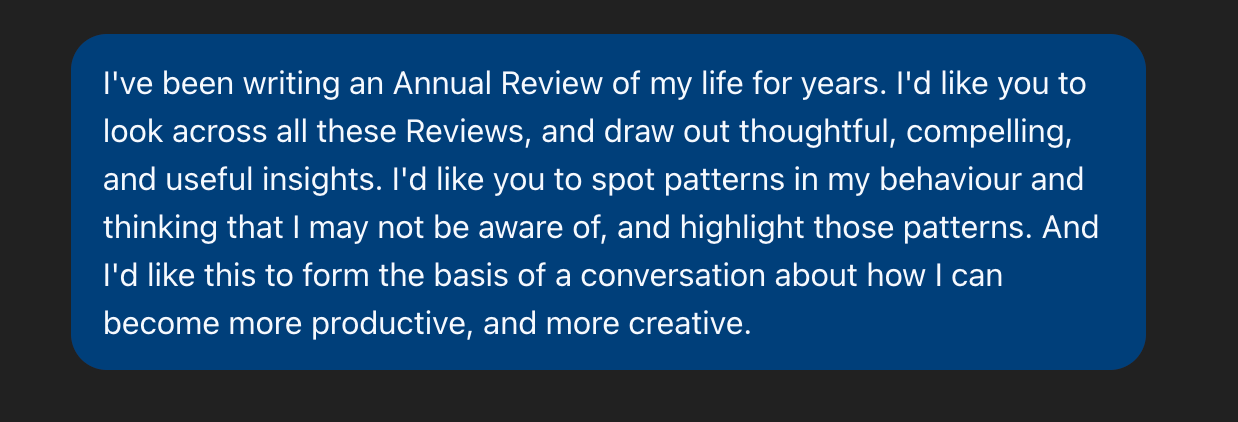
I'm feeding GPT-5.2 all the Reviews I can find, and asking it to provide counsel to me.
I'll share the results here some time in 2026. But for now, an underlying thought.
We hear a lot, these days, about how written culture is in decline. Fewer people buy or read books; it is harder, we're told, than ever to live any kind of life as a writer.
That is mostly true, and an unhappy state of affairs. And yet I can't help feeling the reality is more nuanced. Yes, fewer people buy books. But the online newsletter renaissance — which began in the pandemic — has given rise to a rich, noisy, and flourishing ecosystem of writing, which reminds me of 17th-century England and its mania for pamphlets. I read a lot; sometimes it feels as though I'm reading constantly. But I'm sure my reading has shifted more online over time.
What's more, the AI moment we're living through now adds another dimension to all this. We're often told that the rise of LLMs will spell doom for writers. How will human writers make a mark, amid all that AI-generated text? The question is real, but I'm convinced that LLMs do not spell the end for human writers. First, I think people will always want to read writing from other people; other humans who live, experience, and feel the way they do.
What's more, it seems to me that the rise of LLMs can mean outsized advantages, in all kinds of ways, to people who write. LLMs are hiveminds for the ingestion and output of text. If you have an archive of bespoke text — that is, of your own writing — that you can bring to an LLM, you can coax all kinds of outputs from it that will be in some way exceptional. You can transcend the ocean of average that most AI output will form, and produce something atypical. Those outputs may be useful primarily to you: the outputs ChatGPT will produce on my Annual Review will be an example that falls into this category. Or they may, once combined with further thought and writing of your own, be worth sharing with the world.
I don't want to appear naive. The age of LLMs poses huge challenges to writers. But it offers great opportunities, too.
And so to my appeal: if you don't already, you should start writing. It's never been a better time to externalise your thinking in this way; to put hand to keyboard and get something down. It could be an essay. A diary. A series of scattered ideas, notes, and fragments. It all counts. And it will accrue over time.
And once it does, you have an archive that you can use as you wish. No serious creative person would ever let an LLM do their writing for them; that goes without saying. But bring your writing into collision with an AI; use it to develop new ideas, thoughts, angles. And then write again. You'll end up in the most unexpected of places.
Writing is, in the end, the oldest technology we have. And it's still the most consequential. Which makes for a neat segue into Mark's reflections.
The Two-Sided Gift
(Mark) As many of us go on holiday, and all of us head towards a change in year:
- a thought I've spoken about before, more relevant today than ever
- and two links to current rich ideas
The thought is — appropriately, at Christmas time — about gifts. The American technology writer Erik Davis in his book Techgnosis relates the following story, taken in turn from Plato, and narrated by Socrates. It concerns Thoth, the Egyptian god of magic and invention.
“…One day Thoth approached King Thamus with an offer of a brand new techne (art): writing. By giving the gift of writing to the king, Thoth hoped to pass on its wonders to all of the Egyptian people, and he promised Thamus that the new invention would not only augment memory, but amplify wisdom as well. Thamus carefully considered the matter, weighing the pros and cons of this major communications upgrade. Finally the king rejected the gift, saying that his people would be better off with out the new device. And reading between the lines of the story, it’s clear that Socrates and Plato agree.”
Thamus feared that the gift of writing would take away his people’s memory. He reasoned that once you can write ideas and stories down, the facility to remember them would fade. As Davis points out, it is hard to disagree when you consider the loss of oral tradition in societies that have put pen to paper, and ink to press.
Well, Thoth has been laying on the gifts thickly recently, and we have no all-powerful Thamus to say no thank you. As media guru Marshall McLuhan observed some time ago, when you gain from technology, you always lose something too.
We cannot take for granted that all progress is good, as the Victorians did. In Why Things Bite Back the innovation expert Edward Tenner developed a compelling theory that every technological advance carries with it what he called a revenge effect: a kind of unintended consequence. Frequently this is chronic and long term, by which he meant low level and hard to detect. But the revenge effect is often much harder to deal with than the problem that was being addressed in the first place.
Isn't that what we see with social media now? Another example: pesticides eliminate pests, but damage other parts of the food chain too, which in time makes the growing of crops harder because natural predators of other pests are affected for the worse. Indeed, the original target pests often out-evolve the poison, and the new superbugs are much harder to deal with.
Bear all this in mind when you look at or listen to the excellent ideas below, published this month. Both reflect on humans, technology, society, and work.
Derek Thompson is one of the most interesting thinkers out there. This list is very, very good.
 Derek Thompson
The BBC Reith Lectures are always worth a deep listen. This year Rutger Bregman is no exception. Though as you know from a previous post, I disagree with his angle on BS jobs.
Both thinkers are consciously trying to redefine liberalism and a centre-to-left agenda. Worth paying attention to, no matter your political stance.
If you are getting time off, enjoy some love. As Paul McCartney beautifully wrote:
And in the end
The love you take
Is equal to the love you make


Comments