

Only People Can Build Brands That Other People Care About
On brand in the age of intelligent machines


Introduction
I want to tell you about the most influential idea I ever had on brand strategy.
It was an idea about what brand really is, and how brand works, in the age of the internet. And then I want to show that this idea allows us powerful new insights — insights that no one else is articulating, at least not yet — about the nature of brands in the new age that is now arriving. That is, in the age of AI.
First, some background.
Back in the 2010s, I was head of research at a leading consumer trends firm. The team I led scoured the world — and yes, that mainly meant scouring the internet — for examples of consumer-facing innovation. We used those examples to help us spot emerging trends in consumer behaviour, mindset, and expectation, and to chart the evolving relationship between consumers and brands. Our clients were senior marketers, product designers, and strategists at a whole host of household name organisations, from Marriott, to Disney, to Facebook (this was before the latter’s journey into the metaverse).
In 2016, we published a trend that turned out to be one our most successful. It was called Glass Box Brands.
The argument went like this:
Back in the day, a business was pretty much a black box. The walls were opaque; no one could see inside. And the brand? That was painted on the outside of the box. Consumers came to the box and looked at what the organisation had painted. They either liked it, or they didn’t. And so it went with brands.
But then came a revolution. A host of forces converged, and turned the walls of every organisation to glass. This revolution was about transparency, and the way it made it possible as never before to see inside businesses of all kinds.
Employee review platforms, whistleblower culture, always-on news cycles and, most of all, social media: together they made the internal life of organisations visible to the outside world in a new and visceral way. People could suddenly see how a company treated its workers. What its leaders said behind closed doors. Whether its stated values were real or performed.
Remember, this is more than ten years ago. We were all still getting to grips with social media and its implications. The idea that something could happen inside an organisation, and then employees could take to Twitter or Facebook to let the entire world know about it: this was still a relative novelty.
So now, thanks to social media and more, people can see inside an organisation as never before. And that, I argued in the original Glass Box Brands report, had a powerful implication. When people looked inside an organisation — to the people, processes and values — what they were really looking at was the internal culture. And once people could see that culture, they’d start to feel something about it. It would become a part of the set of emotional resonances they associated with this organisation.
In other words, it would become a part of the brand.
That was the core Glass Box Brands insight. In a transparent world, internal culture is a part — and often the most important part — of public-facing brand. You can no longer simply paint a brand on the walls of your organisation and have people accept that. You can’t just tell people what your brand is. You have to live that brand, all the way through.
The idea gained a lot of traction. I talked about it inside boardrooms, and showed this slide a million times.

I traced it through the corporate crises of the era: Uber's toxic culture, Volkswagen's emissions scandal, the Google anti-diversity memo. In each case, what was revealed inside the organisation reshaped how people felt about the brand outside it. This was the Glass Box in action.
Of course, the Glass Box idea is a model; it’s a simplification of a more nuanced underlying reality. Organisations were not perfectly opaque before the rise of the internet and social media; people could still sometimes get a look at what was happening inside them. And organisations are not perfectly transparent now. But the model is directionally correct: transparency has profoundly changed the way brands work. And it has real and powerful implications for people who want to build, and manage, brands.
There have been plenty of examples of the Glass Box in action since then. Transparency has only become more acute. Look, for example, to the way leaked messages from the company Slack, including a huge thread on gender inequality, took the sheen off the Apple brand in 2021. The Apple brand is not what it was, and this peek at the company Slack was a part — albeit just one small part — of the reason for that.
Or look, even, at the two companies at the centre of the AI revolution right now: OpenAI and Anthropic. At heart, they're doing the same thing: building frontier AI models and racing to commercialise them. And yet there is a gulf when it comes to brand. And that’s a lot to do with what we believe is happening inside those organisations; what we believe, that is, about their internal culture. Via blog posts, interviews, leaked memos and more, Anthropic has positioned itself as a culture that is deeply concerned to build frontier AI that serves humans. OpenAI, not so much.
Most recently, Anthropic CEO Dario Amodei used a ‘leaked’ internal memo to voice his opposition to the Trump administration and its attitude towards AI as a military technology. In the wake of that furore, Claude downloads spiked nearly 70 per cent in a single day. Anthropic's brand sentiment surged. Claude is building the same technology as OpenAI, but the two organisations have radically different emotional signatures. And that’s a lot to do with what we know about their internal cultures.
That's the glass box, still doing its thing after all these years. The framework still holds.
But now, something is shifting. That is to say, something is happening now that the Glass Box idea didn't anticipate. Something that threatens to upend the entire framework.
The deep question we are approaching is this: what happens to the glass box when you replace the people inside it with machines?
The Handover
In February this year, Jack Dorsey made an announcement that sent a jolt through the corporate world.
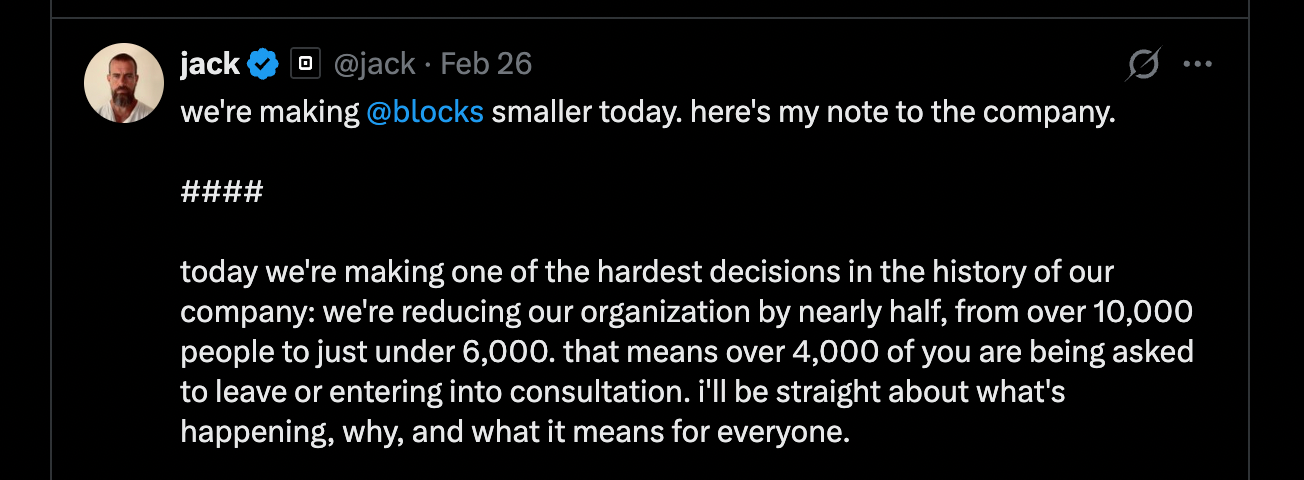
Block — the company behind Square and Cash App — was cutting its workforce by 40%. The reason, Dorsey said, was AI.
‘Intelligence tools have changed what it means to build and run a company,’ he wrote in a letter to shareholders. ‘A significantly smaller team, using the tools we're building, can do more and do it better.’
In a company memo, he reportedly distilled it further: ‘100 people + AI = 1,000 people.’
Dorsey predicted that most companies would reach the same conclusion within a year. ‘I'd rather get there honestly and on our own terms,’ he wrote, "than be forced into it reactively.’
Some argued that Dorsey was using AI as an excuse for layoffs that needed to happen anyway, to correct for overhiring during the pandemic. Dorsey pushed back against those claims.
In any case, within weeks reports emerged that Meta was preparing a similar move: a 20 per cent headcount reduction tied to AI capabilities. Salesforce had already cut thousands of customer support roles and replaced them with AI agents. Shopify's CEO told employees that teams must prove a job can't be done by AI before they're allowed to hire a human.
The conversation around AI and knowledge work has shifted, and fast. That conversation, now, is about a shift from AI as tool to AI as worker: an autonomous agent that does the job itself.
And in some boardrooms, executives are already arriving at something even more radical: AI as organisation. The idea that an entire company can be restructured around machine intelligence, with a small residual human workforce overseeing the process.
Microsoft's AI chief, Mustafa Suleyman, recently warned that white-collar workers have a year to eighteen months before they face widespread displacement. Andrew Yang and Jamie Dimon have said broadly the same thing.
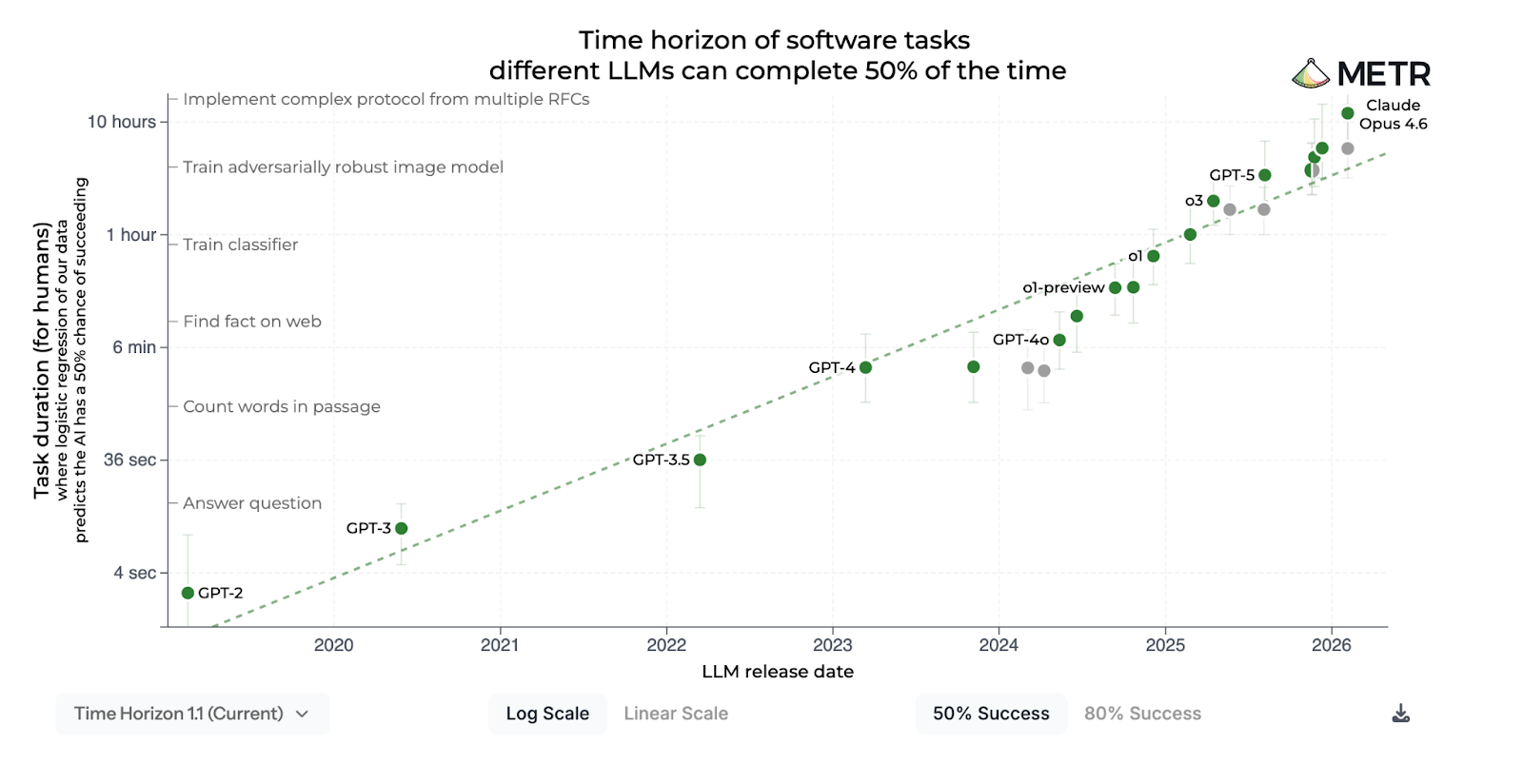
We should take every announcement of ‘layoffs because of AI’ with a grain of salt. And we should be wary of overclaims when it comes to the real capability of AI agents. Still, the narrative now in play — a narrative about autonomous workers or even autonomous organisations — is supported by hard evidence on the accelerating capability of AI.
The direction of travel is pretty clear:
And what I’m interested in here is: what does this shift mean for brands?
When you see all this in light of the Glass Box idea, you’re thrown on a deeper set of questions. Remember, the fundamental Glass Box insight is that in an age of transparency, internal culture is a crucial part of public-facing brand.
So in the age of the AI agent, the question now becomes: what happens to internal culture — and by extension, what happens to brand — when you replace the people inside your organisation with intelligent machines?


