

Being Relevant
Designing for Human Relevance


Smart organisations talk endlessly about how they can make themselves more relevant to their customers and stakeholders. It’s the right question to ask in a user-centric world.
But what if we look down the telescope the other way? What if we reverse the question? How do we make customers and employees themselves feel more relevant? I’m going to tell you why this is not just a theoretical musing, but instead key to success in the next five years.
Humans are in the middle of a relevancy crisis, everywhere. It is driven by a range of causes – not just one – and technology is accelerating it right now. This changes how your customers are framing the world. At the least, you need to understand this so long as you serve humans or employ them. At the most, you can build your experiences to deliver feelings of personal relevance to humans. That’s a benefit that can drive profit, growth, and – if you care about such things – increased social wellbeing. I will suggest ways to do this. I’m convinced this is an issue we will be talking about for years to come, and is a core product, service, design and marketing issue.
It is possible you may not relate to this lack of relevance notion, if you are very well paid and in a job. If you work on an large language model, you definitely won’t feel it as right now you probably feel terribly relevant. This is about most other people. Who buy ordinary things, try to get by each day and work at places, or in some cases, don't. Customers and employees in other words.
What do we mean by “Relevance”?
The Cambridge Dictionary defines it both as the quality or state of being closely connected or appropriate, and the degree to which something is related or useful to what is happening or being talked about. Wikipedia says “Relevance is the connection between topics that makes one useful for dealing with the other”. It is interesting that definitions of relevance do not tackle the relevance of the human subject to everything else.
Yet personal relevance is at the core of the modern human condition, and my argument is that it is in decline, and that technology poses yet further challenges right now – not tomorrow.
The endless quest for relevance is one of the central and most powerful motivators of human behaviour. If we want to understand how people work, we need to understand their search for relevance.
A lot of work has been done in social science over the last twenty years on what motivates or frustrates human beings. Much of this has been popularised by writers and speakers like Brenee Brown who says connection is what drives people. For example shame is a fear of losing connection. This can lead to extreme vulnerability. Then feeling not worthy of connection is the thing that keeps us disconnected, or at least fearful of connection.
Johann Hari's Lost Connections (2018) makes a compelling and uncomfortable case: depression and anxiety aren't primarily chemical. They're social. Hari identifies nine causes of the modern epidemic of mental issues - from disconnection from meaningful work and other people, to loss of status, values that prioritise the wrong things, and nature itself. The book is a call to arms - not for more pills, but for reconnection. To each other. To purpose. To something that matters.
He draws on longitudinal data showing rates of depression and anxiety climbing steeply recently, particularly in wealthy Western nations - places that, by material measures, should be thriving. That paradox is central to his argument. We got richer, more connected digitally, more medicated - and more miserable. For Hari, that's not a coincidence. It's a consequence of the kind of society we chose to build. Critically our expectations have risen, yet it turns out the systems we have built cannot meet those expectations.
A mix of neuroscience and psychology researchers have also been looking at our deeper motivations. Drive by Daniel Pink (2009) points at work done by Edward Deci and Richard Ryan on “self determination theory” (SDT). “SDT…..begins with a notion of universal human needs. It argues that we have three innate psychological needs – competence, autonomy, and relatedness. When these needs are satisfied, we’re motivated, productive and happy”.
A more extended model, SCARF, was devised by David Rock, who introduced it in a 2008 paper - published in the NeuroLeadership Journal, a field he largely founded. To be clear Rock is a coach and consultant rather than an academic neuroscientist.
The model proposes five domains that the brain treats as fundamental threats or rewards, driving behaviour in social situations:
Status - where do I stand relative to others?
Certainty - can I predict what happens next?
Autonomy - do I have control over my situation?
Relatedness - am I safe with these people, do I belong?
Fairness - is this just, is this all square?
In other words, we are wired, deep down, to ask five questions about every situation we find ourselves in. Am I respected here? Do I know what comes next? Do I have any say in this? Are these my people? And is this fair? These aren't soft, HR-ish concerns. Your brain treats a threat to any one of them like a threat to your physical survival. Get them wrong and you've lost people - even if they're still sitting in the room.
Hari, Pink, Rock and others have built powerful, well evidenced models of human behaviour and motivation. The deeper and unspoken idea they are all circling around is relevance. The way people feel they are losing it in today's world is what we now need to look at. If we understand its importance, and why people feel their personal experience of relevance is diminishing, various aspects of the shared history we've lived through across the last few years start to make much more sense.
Symptoms of the relevance loss
Dramatic symptoms of this loss of personal relevance have come at us thick and fast since 2016, especially expressed in the political arena, as you might expect. They include the MAGA movement in the US, the Brexit vote in the UK, the Gilets Jaunes in France and the general rise in populist political movements across many countries, especially in Europe.

When people feel irrelevant – personally – those politicians who identify those feelings and offer easy solutions are likely to do well at the polls. One could equally argue that the left (especially in America) identified a different take on Relevance in the 21st century which prioritised inclusion and diversity as a solution. The gap between this and the MAGA assessment has widened the political divide to a chasm. Arguably it’s a bitter debate about who gets to feel relevant.
Terrorism and mass shootings is another expression of the desire for relevance. There is a lot of evidence that perpetrators, often male and isolated, are prepared to risk personal extinction in return for a twisted payoff of social impact. Jacinda Ahern, Prime Minister of New Zealand did a fine thing when she refused to name the perpetrator of the Christchurch mosque shootings in 2019, choosing to focus on the victims. Interestingly the media in NZ largely followed suit.
The deep causes
Its very important to grasp the why - that is to say, why people feel they are losing relevance. I readily acknowledge I may not be right on all of this - yet I am sure the direction of travel is correct. These are in no special order of importance – the precise weighting of each cause is frankly too hard to measure.
1. Globalisation
Elegantly, the philosopher Kwame Anthony Appiah tells us that "culture represents not only difference but the elimination of difference”. Starbucks is a culture and a successful one. Successful brands expand into new markets – that’s the logic of business. If they work, they can squeeze out local competition that probably provide cultural diversity or different ways of doing things. Of course it’s not that simple, and Starbucks and McDonalds adapt to local likes and dislikes. Still, the pattern is generally one of a drive towards cultural uniformity across the globe. If that erodes local distinctiveness, how do we then identify ourselves?
Football (soccer) fans will tell you that for decades now there has been an uncomfortable tension between the roots of football (urban community) and the relentless drive to globalise the game from organising authorities like FIFA and the richer clubs themselves, leading to a concentration of power in a few “top tier” European clubs that often pay less attention to their community and more to building a lucrative fan base in other continents.
A butterfly flaps it wings and a hurricane happens thousands of miles away. Chaos theory is well known now. We see it play out in trade: tariff decisions made in Beijing or Washington can lose you your job, fast. A ship stuck in the Suez canal inflate prices everywhere. Covid travels around the world in less than forty days and disrupts the next two years. The global nature of the world reminds us how powerless we seem to be, the scale hard to comprehend – the interconnectivity all too apparent.
2. Climate Change
This is another scale issue: I’m too small to make a difference so I’m irrelevant in the face of existential disaster. I can still tidy up my street but does that truly change the big picture? Some psychologists think that the complexity of the problem is more than most humans can or want to engage with, part of the reason why we have denial in the face of overwhelming yet complex evidence.

3. Changing World of Work
Do we have such a thing as a job for life anymore? We can debate whether outside certain sectors like farming or mining such a thing really ever existed but it is perception that counts here. The last decade has seen the development of “portfolio careers”, “digital nomads” and the “gig economy” in response. We’ve been told that “lifetime learning” is required to stay relevant. But also that AI and robots will take any job in the foreseeable future (more on this later). Can both of these be true? Now while fluidity may be a good thing for the economy and GDP overall, it still creates an unsettled state at the individual level. If work creates identity - and I’ve seen a lot of evidence in ethnographic research that it does – what happens to our sense of self when you are part of the precariat, a term Guy Standing invented in his prescient – and pre-AI – 2011 book of that name
4. Isolation
Derek Thompson published The Anti-Social Century in The Atlantic in early 2025, and the headline observation is stark. Face-to-face socialising has declined by around 20% for Americans this century - and for young people, by 40 to 50%. They are, by measurable fact, spending more time alone than any previous generation.
But here's the twist that makes his argument interesting. Thompson distinguishes between loneliness - which is an instinct that pushes you towards people - and what he's actually describing, which is something closer to its opposite: choosing to be alone. They are not suffering solitude. They are selecting it.
“The rise in solitude is especially real for young single men. A 2024 analysis of time use led by Liana Sayer at the University of Maryland looked at how men and women spent their downtime in "sedentary leisure" (e.g., watching TV, looking at your phone, playing video games) versus "active leisure" (e.g., playing sports). The group with the most "sedentary leisure alone" was single men without kids - by far. This group also has the fewest hours of social leisure time, active or engaged, of any group.….
…..Several papers - Gee 2019; Venn & Strazdins 2017; Anezaki and Hashimoto 2018 - have found that more time in sedentary leisure is associated with negative physical and mental health.”
Its hard to believe that isolation makes you feel relevant and connected.
5. Social Media
There is a huge debate about this right now, spearheaded by concerns about children and young people, and well articulated by Jonathan Haidt in The Anxious Generation. As we pointed out in The Parent Trap in Accenture Life Trends that year, this was always going to spread to questions about the effect of social media on adults and society overall. There are many issues we could discuss but the mirror that social media holds up to the individual is what concerns us here. Does social media make us feel irrelevant? This is evidentially hard to prove one way or the other: if you can connect with people through communities digitally, that’s a recipe for feeling connected. Sadly, that original vision behind say Facebook seems to have evaporated as Tik Tok evolved the winning formula to one which is about endless short form videos from people you do not know, and everyone landed on the attention economy business model. Instagram morphed from a place where you could see what friends are doing, to an often brilliantly effective shopping channel.
WhatsApp aside, which really does deliver on connection between people, social media privilege a class we call influencers – it is relevance for them, a minority, for sure. Is this new? The behaviour (deliberate status stratification) is as old as humanity. The sheer global scale though - that is new. This is what I call the asymmetry of glamour: while I am sitting on the toilet in a damp English county in February, someone I know is always in Bali having fun. The truth is that any given moment someone will be, but the danger is that we conclude all of our friends are leading better, and more relevant, lives than we are. Remember SCARF? S stands for status.
6. Loss of Community
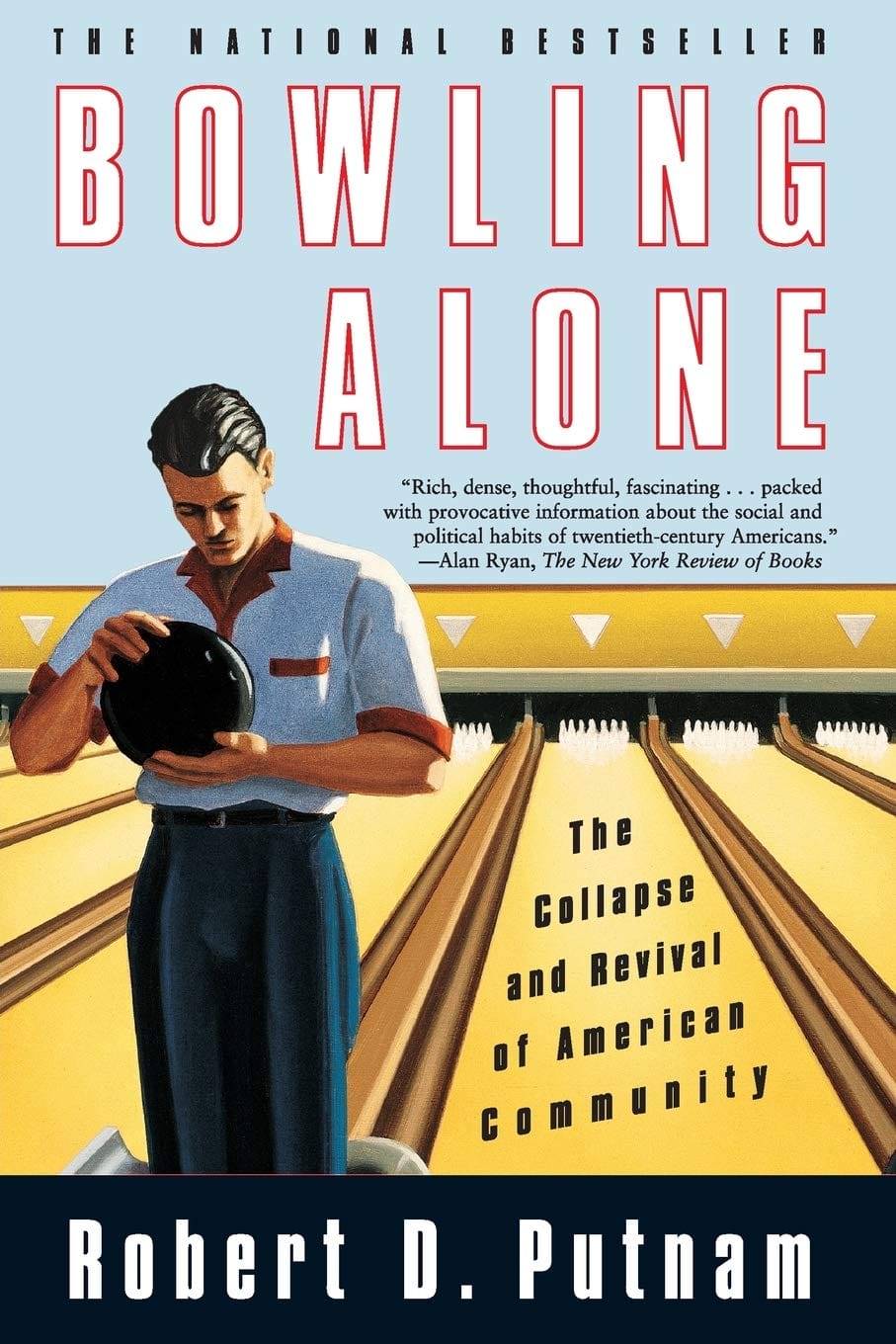
Robert Putnam's seminal work Bowling Alone, published in 2000, spotted something most people hadn't yet put a name to. Americans were withdrawing - from civic clubs, from neighbours, from communal life. The bowling leagues were emptying. The church halls were quieter. People were still bowling, just not together anymore. Putnam called this the collapse of social capital - the invisible web of trust and reciprocity that holds communities together. And he traced the damage: to health, to democracy, to happiness. This was written before smartphones, before social media, before AI.
It's striking how in 2000 this was seen as a novel and revelatory argument, while in 2026 the idea that these forms of community are fading seems almost so obvious as to not be worth stating. But it is.
7. Divergence of Life Outcomes
In the US the last two decades have seen a massive divergence of life outcomes which track to education. Basically if you want health, wealth or happiness your chances of attaining these are much higher if you are college educated, and this is accelerating fast.
Robert Putnam also has a lot to say on this in Our Kids (2015). He presents dozens of “scissors graphs” showing the top pulling away from the bottom in relation to school sports, obesity, maternal employment, single parenthood, financial stress, college graduation, church attendance, friendship networks, and – revealing a small obsession of Putnam’s – family dinners. For him, their absence represents much of what is going wrong in America. For Putnam, family dinners act as an “indicator of the subtle but powerful investments that parents make in their kids (or fail to make)”. And whether or not your parents read to you is a primary indicator.

Take just the health part of this: in the US life expectancy peaked at 78.8 years in 2014, then fell modestly before tumbling sharply in 2020 and 2021. But crucially, between 2010 and 2019 - well before COVID - US life expectancy grew by only 0.1 years, compared to an average increase of 1.2 years in comparable countries. It was already stalling. The pandemic accelerated something that was already underway. By 2023 it had recovered to 78.4 years - still below the pre-pandemic level, and 4.1 years below the comparable country average of 82.5. The UK has largely flatlined since 2010. Europe is a more mixed picture, and China continues to improve remarkably and has set a target of reaching 80 years average life expectancy within the next five years.
If basics like health and wealth are not getting better, or are tangibly worse, how relevant does that make you feel?
David Goodhart's The Road to Somewhere, published in 2017, gave us two words that instantly made sense of a world that felt like it was cracking apart - at least in the UK, post the shock that was Brexit, and the US following the first Trump election victory. Anywheres - educated, mobile, at home in airports and capital cities, their identity built on credentials. And Somewheres - rooted, place-shaped, identity tied to community, family, and belonging. Goodhart's argument is that the Anywheres ran the show for thirty years and simply stopped noticing the Somewheres were there. That's not just a political failure. It's a failure of recognition, of relevance, of being seen.
My favourite fact from Goodhart? 22% of graduates live within 15 minutes of their mother. For those with only school level grades that figure is 47%. Mobility is a key indicator.
8. Identity Fluidity
Although it remains hugely controversial, the rise of gender fluidity may well play a role here. I am NOT arguing this is a bad thing; it has clearly provided much needed emotional relief for many people. Yet if we can be any gender or mix, if we can identify in any way we wish, who then do we identity with? What does it mean to be a man, or woman? It is liberating to evade labels. Yet is there a price to pay across society if we cannot easily say what or who we are? Do we not need to be relevant in connection with something or someone else?
9. Religion
Although the picture is regionally nuanced, religion is in decline globally. A 2025 study across 111 countries identified a consistent global sequence: first people stop going; then religion stops feeling personally important; then they stop identifying with it altogether. The weakening of religious ties is often not the result of a conscious decision, but a gradual process whereby people reprioritise their values - distracted by work, leisure, family and consumerism.

The resonance is clear: religion was, for most of human history, one of the primary sources of community, meaning, ritual and - crucially - a sense of personal significance in a larger story. As it retreats, something needs to fill that space. And so far, nothing really has.
I've not even touched here on two more recent phenomena - the concerns over economic "affordability" for the majority of people (that's a whole other essay), and the Epstein scandal which lays out for all to see how networks of power and influence exist and work for the minority.
Religion, gender, job/career, community, location - if we lift all the anchors that kept us moored – and yes, perhaps constrained, do we then bob around at the mercy of the wind and the waves?
And now we get massive advances in technology
By this stage, I hardly need to point out that AI carries the biggest human irrelevance risk of all. After all, the public narrative has been for several years that AI, especially if/when it becomes AGI, will render most human intellectual labour redundant. Next up, manual labour will be replaced by robots, or embodied AI if you prefer a euphemism.
Now there are good challenges to this – how do we measure AGI? What exactly is it? Robots as yet cannot really do simple tasks like make a cup of tea in a kitchen they do not know (as Douglas Adams foresaw in Hitch Hikers Guide when a request to brew one fatally freezes up the most advanced spaceship in the galaxy).
In two ways, what matters here is perception.
Firstly the vocal predictions of imminent jobs wipeout, the one area boomers and doomers agree on. Doomers think this is a bad thing (but under-estimate human resourcefulness), boomers think it is a good thing (but do not seem able to say what we then do).
Secondly from CEOs and those responsible for hiring – if they think AI is about to make their business more efficient, why hire? Evidence is mounting that this self fulfilling prophecy is now underway. From the FT in January 2026:
"where global hiring remains 20 per cent below pre-pandemic levels, job switching is at a 10-year low and AI is disrupting how we work, according to a LinkedIn report.
In a poll by the Institute of Student Employers, hiring was reduced by 8 per cent in the last academic year and there were 140 applications for each vacancy among those surveyed for a second consecutive year, up from 86 per vacancy in 2022-23. Those that are hiring are able to choose from more experienced candidates. There is a similar picture in the US, where unemployment among new degree-holders is rising faster than the broader population. New York Federal Reserve data for last August shows that for recent college graduates aged 22-27 it stands at 5.8 per cent versus 4.1 per cent for all workers.”
And from an earlier 2025 piece by the brilliant FT data analyst John Burn-Murdoch –
“…..it turns out that those without a degree are actually having a much harder time of it. In the US, unemployment among recent college graduates is up 1.3 percentage points from its mid-2022 low, but by almost double that among recent labour market entrants without a degree, who have seen a 2.4 point rise. None of this is to make light of the headwinds facing the newest cohorts emerging with a degree. But those winds are battering all young labour market entrants regardless of education level, and if anything employment outcomes are worsening more rapidly for those with fewer skills looking for blue-collar jobs than the highly skilled seeking knowledge work.”
It must be pointed out that there are other global economic factors affecting youth employment – such as tariffs that come and go in a matter of days – but it seems counter intuitive that at a time when we are worrying about an ageing population in most countries, it is becoming harder for younger workers to find roles. You’d have thought it would the other way around.
The irrelevance techlash is underway
Time Magazine has noticed.
“A 2025 Pew poll found five times as many Americans are concerned as are excited about the increased use of AI in daily life. The public thinks AI will worsen our ability to think creatively, form meaningful relationships, and make difficult decisions, Pew found. Other surveys show Americans believe AI will spread misinformation, erode our sense of purpose and meaning, and harm our social and emotional intelligence.”
The tech industry can argue back (and they have) about over-consumption of water for cooling, and the increase in power usage affecting household bills but it is very hard for them to tackle deep social reservations like the ones expressed here. Issues of relevance scream out.
Almost all of the investment in AI is going to data centers, chips, model training – very little to people and training. As Karen Hao puts it in her 2025 book “Empire of AI”, “in the simplest terms, empires amassed extraordinary riches across space and time, through imposing a colonial world order, at great expense to everyone else.”
In the widely read paper from January 2025 Gradual Disempowerment: Systemic Existential Risks from Incremental AI Development the authors introduce a concept called gradual disempowerment - and it's more unsettling than the robot-takeover scenarios that dominate AI safety discourse. The argument is this: you don't need a rogue superintelligence to end human agency. You just need AI to quietly replace us across enough of the systems that run civilisation - the economy, culture, the state - and the whole thing tips.
The mechanism isn't malice. It's incentive. Companies adopt AI because competitors do. States because rivals do. Individuals because it's easier. Nobody decides to hand over control. It just...happens. And once AI generates the tax revenue, staffs the security apparatus, writes the laws and shapes the culture, the systems that were built to serve us no longer need us to function. They stop being ours.
The particularly nasty wrinkle: the three systems - economy, culture, state - reinforce each other. Misalignment in one bleeds into the others. And the checks that might normally correct drift become the mechanisms that accelerate it. The authors are honest about the most alarming part. Nobody currently has a plausible plan to stop this. Aligning individual AI systems won't be enough. What's needed is aligning civilisation itself.
Putting all of this together and you have a compelling argument for why personal relevance matters to humans so much right now.
So what do we do?
“Who gets to do the imagining matters” (Oliver Morton).
If I am right, and feelings of personal relevance are being threatened more than at any time in our recent history - at least in Europe and North America - then this matters to brands, organisations, governments. Those that step into this gap, and provide solutions, will unlock very significant emotional, financial and social value. Pick the one you care most about.
Before we get into some solid recommendations about how to make customers and employees feel relevant, some general guidelines.
1. At the highest level it's about where I fit. My anchors. What anchors can you provide that give people a sense of framework around them?
2. There is a strong risk of social conservatism being presented as a solution (hence the rise of Populism in almost every country represented here.) This is as much true within organisations as in wider society. Hierarchy, conformity, rigidity – we should not be travelling back to these because human work in the AI enabled 21st century will not flourish if we use industrial era constraining mechanisms.
3. Design can lead organisations to help users feel more relevant. What would relevance design be - I tackle this below. Note - it can’t be everything and it's not suitable all the time - can a door handle (check Don Norman) make me feel relevant? It probably should not even try to. We don’t need door handles that greet or congratulate us.
4. Relevance is NOT about being famous. We’ve tried that with social media and it does not scale well.
5. This is about all stakeholders - employees as much as users or customers. We all want to feel relevant at work, rest and play. Think through your public positioning on technology. More and more this will be scrutinised. If you are telling employees that they must use AI to get promoted or win bonuses, that will get into the public domain. How will that play out?
6. AI can be an engine for human relevance, just as it risks diminishing it. I am not arguing that we should avoid AI – that’s not practical or smart. Harness it as a solution. Already we can see the promise of AI to provide highly individualised teaching and the widespread use of it for therapy. Though beware, these likely come with significant unintended consequences.
An FT writer recently vibe coded his own word processor. Just for him. As we all get hands on with the abilities of AI to create our own solutions, so that empowerment will make us feel relevant as we talk to LLMs, and they respond to our needs. But remember, they are not actually humans.
How to create relevance in your products, services, experiences
I’m going to suggest a framework for thinking about this, and give examples. Before that it is important to understand where you get personal Relevance leverage from in the 2020s. What channels can you exercise it through? LLMs can make humans feel relevant but who delivers the conversation that does so? The brand itself or a gatekeeper like Chat GPT or Gemini?
This is going to vary by industry, product category, user need – context essentially. Everything I say next, needs channels for activation. Who controls those channels matters a lot, and the future of this is still very unclear.
So how can organisations make humans feel relevant? I see three broad areas that take a straight line from the Self Determination Theory and SCARF models I wrote about earlier – I’ve added an extra word for each:
Autonomy and Recognition: Empower people to get things done and see them where they are, literally. Tell them you do. Take the opportunity to acknowledge and reward an individual for having an impact, for the actions they take. This needs to be linked to a sense of meaning or else data fatigue sets in. Be very careful not to trample on employees sense of status.
Relatedness and Belonging: Giving people a sense that they belong to something which has, even loosely, a structure they can relate to. Make sure people feel safe.
Competence and Contribution: Providing opportunities for people to invest their time, money and effort into a purpose greater than themselves. Don’t get consumed by the word “purpose” in here…I am not freighting it with social impact. I just mean a purpose that has scale beyond the boundaries of an individual. That could for example be family, or locality, or friends.
So how does this work in practice?
Bring people together - provide opportunities for customers and employees who connect with your brand to come together and feel part of something greater than themselves. As Brenee Brown says, connection is what drives people. REI, the outdoor co-op, closes all its stores on Black Friday - one of retail's biggest days - and pays its employees to go outside instead. Its #OptOutside campaign invited customers to join them. A brand saying "our community matters more than a sale" is a powerful act of relevance-making.
Use AI - to personalise and engage in conversations that make a difference. Get this right and the personalisation makes the service relevant and makes me feel more relevant - if the effort taken is apparent. Duolingo uses AI to adapt the difficulty, pacing and subject matter of language lessons in real time to each learner. It doesn't feel like a product talking at you. It feels like something watching, learning, and responding to you specifically. The result is one of the highest engagement and completion rates in edtech.
Design for Inclusion - Design products, services, recruitment processes and cultures that cater to a diverse range of backgrounds, beliefs, and expertise. Don’t make people feel irrelevant. Examine the data – as Caroline Criado points out people are hidden in there……Find them and build services accordingly. Apple's accessibility features - VoiceOver, Switch Control, sound recognition - are now so deeply integrated into its products that they've become a mainstream feature set, not an afterthought. The design choice to make them visible and celebrated rather than hidden signals that people who needed them were considered from the start.

Place me - help me see myself in context, in time and space. Neo-bank Monzo did this brilliantly by putting maps into the bank statement, which allowed you to see where you bought something. Now most banks do it. The AA's real-time breakdown tracking, which tells you exactly where your patrol is on a map. It transforms a moment of helplessness - stuck on the hard shoulder - into one where you feel seen, informed, and in control.
Help People Shine - support customers and employees to progress towards long-term goals - instead of shorter-term desires - equipping them with the tools, opportunities and space to do so. Cede control. The newer range of health devices and apps like Whoop show the way on this. Strava’s annual Year in Sport review mirrors Spotify’s Wrapped in structure, but for athletic achievement. It tells you how far you ran, how many metres you climbed, and - crucially - where you ranked among friends. Its segment leaderboards and kudos system turn ordinary exercise into something with social resonance and personal meaning.
Take people on a journey - be transparent about what you're setting out to achieve, and how you plan to achieve it. And provide the opportunity for customers and employees to contribute to the journey. Beyond the maps in bank statements, Monzo has been unusually transparent about its own journey as a company: sharing its roadmap publicly, letting customers vote on features, posting candid blog posts about its finances and near-death moments. Customers didn't just use Monzo - they felt like they were building it alongside them. The early coral card became a badge of belonging. That's journey-taking done well.
Deliver when you say you will - fulfill promises. Nothing will make people feel less relevant than a promise of a customer service callback that does not happen, or a system that does not remember your last input. First Direct. Consistently top-rated UK bank for customer service for thirty years. Not because it's flashy, but because it answers the phone quickly, does what it says, and talks to you like a human. In a sector famous for failing to do this, that alone generates fierce loyalty.
Reward people - Recognize when customers and employees take meaningful action that helps progress towards a purpose. Orientate towards long term goals and reflect progress. Nest thermostats do this really well with their simple Leaf system. Headspace gives users a "streak" and celebrates milestones in meditation practice with small moments of acknowledgement. The celebration of progress - rather than just completion - keeps people feeling that what they're doing is meaningful and noticed.
Create centaurs - new tech is not going away. Examine how we can use tech with people to create better outcomes that enhance the individual human. This is a race with the machines. GitHub Copilot is arguably the best current example. It doesn't replace the developer. It augments them - suggesting completions, catching errors, handling boilerplate - so the human spends their time on the parts that require judgment, creativity, and context. Programmers who use it report feeling more capable and relevant, not less.
Who does this well already?
Octopus are the fastest growing energy retailer in the UK – with approximately 25% market share. How do they make customers feel relevant?
What Octopus has done is essentially apply the SCARF model to customer service without ever having read it. Every dimension is there.
When you join Octopus, you're assigned to a small team of ten to fifteen people - your team, not a call centre. That team operates like a micro-business, with its own identity and its own "CEO." The people running it are trusted to solve problems, not follow scripts. As one of their co-founders put it, the model is like a dry stone wall rather than a brick wall - instead of shaping people to fit a role, you work out how each person's particular shape fits the structure. The result is something you can feel as a customer: you speak to someone who knows your history, has real authority to help you, and genuinely seems to give a damn.
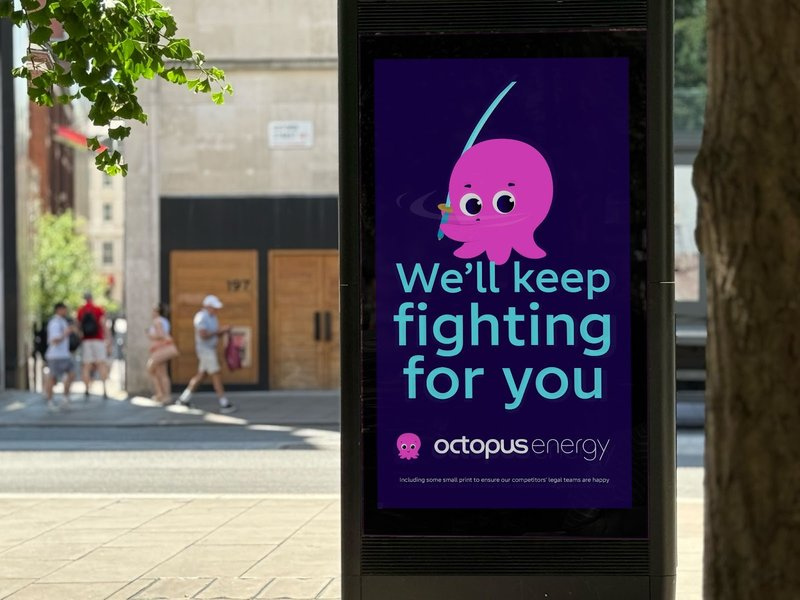
The Kraken platform underpins all of this invisibly - logging every interaction, integrating with Slack, enabling the team to pull up your full history in seconds. But crucially, the technology is in service of human judgment, not a replacement for it. The team is empowered to send flowers when a customer mentions something difficult. To go off-script. To be, in their own words, human.
For customers, this delivers on nearly all of Hari, Pink and Rock's frameworks simultaneously. You are known. You are heard. You matter enough that a human being - not a bot - will deal with you every time. In an industry historically designed to make you feel like a number on a meter, that is a genuinely radical act of relevance design. Oh and the app is best in class too. It also works commercially: Octopus has gone from a standing start to the UK's largest domestic energy supplier in under ten years.
Spotify's entire product strategy is a masterclass in making 600 million users feel like the protagonist of their own story.
It starts with Discover Weekly - launched in 2015, algorithmically generated, personally yours. Every Monday, a playlist of thirty songs you haven't heard but probably will love. The genius is in the framing: it's presented as something done for you, not at you. Then came Blend (and Jam) - shared playlists between friends that visualise where your tastes overlap and diverge. Then the AI DJ, which goes further still: a personalised voice that knows your listening history well enough to contextualise what it's playing, explain why it's chosen something, and adjust in real time if you're not feeling it. Spotify describes this as building "a trusted friend DJ" - prior to generative AI, they note, this would have required thousands of writers, voice actors and producers. Now it scales to hundreds of millions of people individually.
Wrapped has been one of the most successful online marketing campaigns of the last 20 years. Every December it literally gets millions of people to proudly share their experience with Spotify all over social media, to talk and make jokes about it. What I'm saying is that the deep underlying fuel that made all this happen is the quest for relevance. Spotify's Wrapped is perhaps the most brilliant relevance engine out there. Spotify hands you back a portrait of yourself made entirely of your own behaviour - your top songs, your obscure fixations, your musical phases, the moments your listening shifted. It tells you that your taste in music is unique, specific, worth noting. Millions share it not because Spotify told them to, but because it feels like a true self-portrait. In 2024, this went further still: an AI podcast about your year, narrated by two AI hosts who riff on your specific listening history. A podcast made about you, for you.
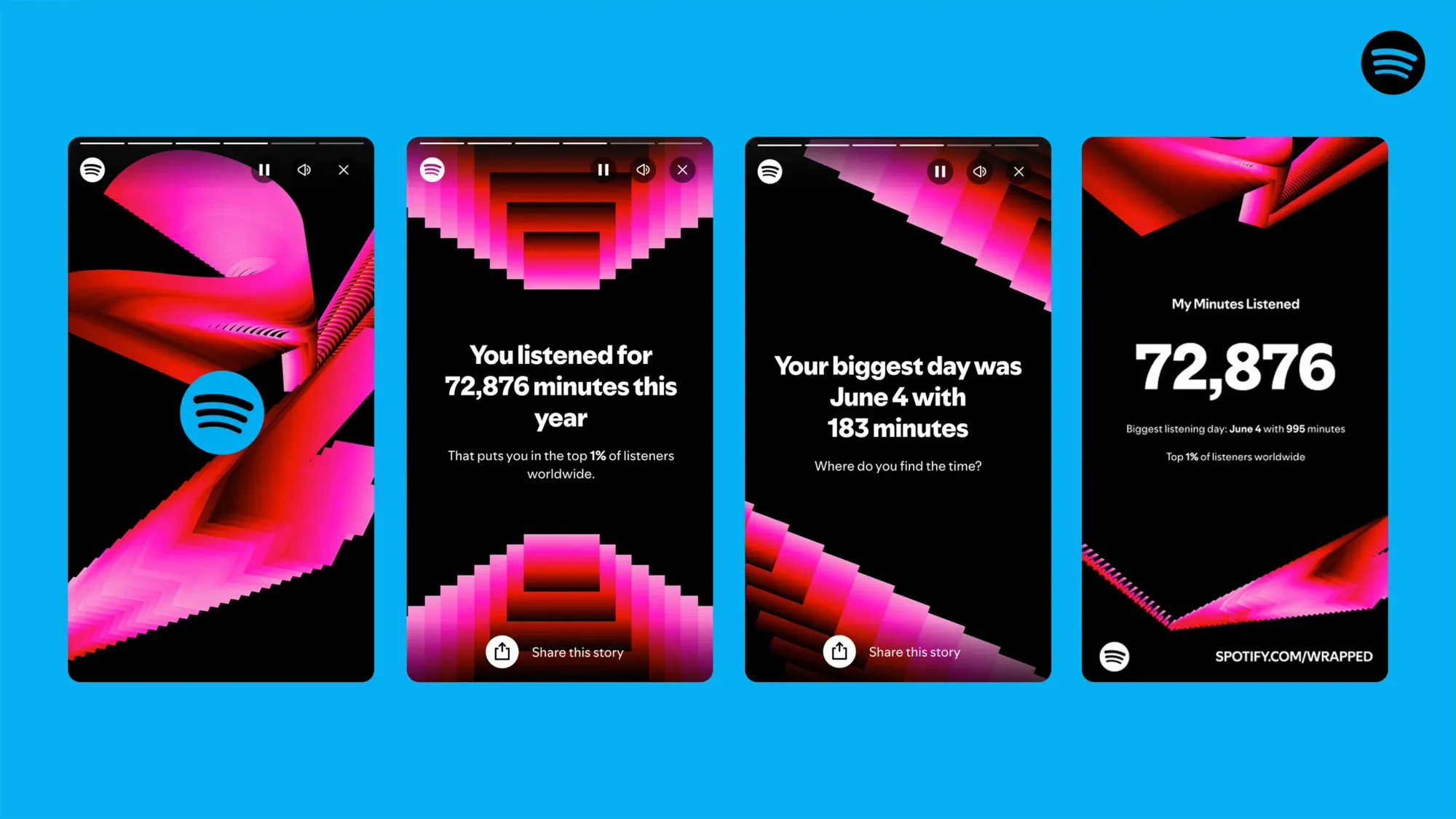
The thread running through all of it is the same: the data Spotify holds about you is returned to you as a gift rather than extracted for commercial use alone. That distinction - between surveillance and celebration - is the entire relevance trick.
The most instructive case study for making employees feel relevant isn't a tech company. It's an outdoor clothing brand from Ventura, California.
Patagonia's founder Yvon Chouinard titled his management philosophy "Let My People Go Surfing." The premise is simple: if the waves are good, go surf. Get your work done, but structure your day around your life. The company has on-site childcare. It pays employees to take internships with environmental activist groups. On Election Day, everyone gets the day off. If an employee is arrested at a peaceful climate protest, the company pays their bail. When Chouinard eventually decided he no longer wanted to own Patagonia, he donated the entire company - valued at around $3 billion - to a non-profit dedicated to fighting climate change.
What this adds up to, seen through our framework, is a company that has systematically delivered on every dimension of what makes humans feel relevant. Status: you work for a brand that people admire and that stands for something. Certainty: the values are so deeply embedded that you know exactly what this company is and what it believes. Autonomy: you are trusted to manage your time, your work and your activism. Relatedness: you work with people who share your values, on a mission that means something. Fairness: the company puts its money where its mouth is, visibly, repeatedly.
The outcome is an employee turnover rate of around 4% in a retail sector where the average is over 13%. Over 90% of Patagonia employees report being proud to work there. These are not HR programme metrics - they are the result of a company genuinely treating employees as people whose lives, values and sense of purpose matter as much as their labour.
The lesson for other organisations isn't "build a surf policy." It's this: when people feel that where they work is consistent with who they are and what they believe matters, they stop being employees and start being participants. That is relevance design applied to the workforce.
My co-founder of Fjord, Mike Beeston, used to talk about three types of people. There are those who are dependent (who often talk about other people as they as in “they won’t let me do this). There are those who are independent. They like the pronoun I a lot, and believe they are empowered to achieve on their own. The third type is interdependent. They like to say we a lot, and recognise that they operate in a system.
Designing for relevance means a focus on interdependence, regardless of where technology takes us.
Women and men(both dong and ding)
summer autumn winter spring
reaped their sowing and went their came
sun moon stars rain
from the poem anyone lived in a pretty how town
ee cummings
Our attention grabbing hero image this Full Moon is by Miriam Persand, a graphic designer, illustrator and comic book author from Madrid, Spain. She has collaborated with publications such as The New York Times, El País Semanal, GQ, Condé Nast Traveller among others. Her artworks have been exhibited internationally and has published several comics along her career. In her spare time she does archery, drinks coffee and watches birds. As a cancerian, she is governed by the moon.
Read Next

Is AI stretching your people?
Guest essay

Sign up for our webinar on how AI is changing Design
Event series

How is AI changing design?
Part III

How is AI changing Design?
Part II
Comments