

Only People Can Build Brands That Other People Care About
On brand in the age of intelligent machines


Introduction
I want to tell you about the most influential idea I ever had on brand strategy.
It was an idea about what brand really is, and how brand works, in the age of the internet. And then I want to show that this idea allows us powerful new insights — insights that no one else is articulating, at least not yet — about the nature of brands in the new age that is now arriving. That is, in the age of AI.
First, some background.
Back in the 2010s, I was head of research at a leading consumer trends firm. The team I led scoured the world — and yes, that mainly meant scouring the internet — for examples of consumer-facing innovation. We used those examples to help us spot emerging trends in consumer behaviour, mindset, and expectation, and to chart the evolving relationship between consumers and brands. Our clients were senior marketers, product designers, and strategists at a whole host of household name organisations, from Marriott, to Disney, to Facebook (this was before the latter’s journey into the metaverse).
In 2016, we published a trend that turned out to be one our most successful. It was called Glass Box Brands.
The argument went like this:
Back in the day, a business was pretty much a black box. The walls were opaque; no one could see inside. And the brand? That was painted on the outside of the box. Consumers came to the box and looked at what the organisation had painted. They either liked it, or they didn’t. And so it went with brands.
But then came a revolution. A host of forces converged, and turned the walls of every organisation to glass. This revolution was about transparency, and the way it made it possible as never before to see inside businesses of all kinds.
Employee review platforms, whistleblower culture, always-on news cycles and, most of all, social media: together they made the internal life of organisations visible to the outside world in a new and visceral way. People could suddenly see how a company treated its workers. What its leaders said behind closed doors. Whether its stated values were real or performed.
Remember, this is more than ten years ago. We were all still getting to grips with social media and its implications. The idea that something could happen inside an organisation, and then employees could take to Twitter or Facebook to let the entire world know about it: this was still a relative novelty.
So now, thanks to social media and more, people can see inside an organisation as never before. And that, I argued in the original Glass Box Brands report, had a powerful implication. When people looked inside an organisation — to the people, processes and values — what they were really looking at was the internal culture. And once people could see that culture, they’d start to feel something about it. It would become a part of the set of emotional resonances they associated with this organisation.
In other words, it would become a part of the brand.
That was the core Glass Box Brands insight. In a transparent world, internal culture is a part — and often the most important part — of public-facing brand. You can no longer simply paint a brand on the walls of your organisation and have people accept that. You can’t just tell people what your brand is. You have to live that brand, all the way through.
The idea gained a lot of traction. I talked about it inside boardrooms, and showed this slide a million times.

I traced it through the corporate crises of the era: Uber's toxic culture, Volkswagen's emissions scandal, the Google anti-diversity memo. In each case, what was revealed inside the organisation reshaped how people felt about the brand outside it. This was the Glass Box in action.
Of course, the Glass Box idea is a model; it’s a simplification of a more nuanced underlying reality. Organisations were not perfectly opaque before the rise of the internet and social media; people could still sometimes get a look at what was happening inside them. And organisations are not perfectly transparent now. But the model is directionally correct: transparency has profoundly changed the way brands work. And it has real and powerful implications for people who want to build, and manage, brands.
There have been plenty of examples of the Glass Box in action since then. Transparency has only become more acute. Look, for example, to the way leaked messages from the company Slack, including a huge thread on gender inequality, took the sheen off the Apple brand in 2021. The Apple brand is not what it was, and this peek at the company Slack was a part — albeit just one small part — of the reason for that.
Or look, even, at the two companies at the centre of the AI revolution right now: OpenAI and Anthropic. At heart, they're doing the same thing: building frontier AI models and racing to commercialise them. And yet there is a gulf when it comes to brand. And that’s a lot to do with what we believe is happening inside those organisations; what we believe, that is, about their internal culture. Via blog posts, interviews, leaked memos and more, Anthropic has positioned itself as a culture that is deeply concerned to build frontier AI that serves humans. OpenAI, not so much.
Most recently, Anthropic CEO Dario Amodei used a ‘leaked’ internal memo to voice his opposition to the Trump administration and its attitude towards AI as a military technology. In the wake of that furore, Claude downloads spiked nearly 70 per cent in a single day. Anthropic's brand sentiment surged. Claude is building the same technology as OpenAI, but the two organisations have radically different emotional signatures. And that’s a lot to do with what we know about their internal cultures.
That's the glass box, still doing its thing after all these years. The framework still holds.
But now, something is shifting. That is to say, something is happening now that the Glass Box idea didn't anticipate. Something that threatens to upend the entire framework.
The deep question we are approaching is this: what happens to the glass box when you replace the people inside it with machines?
The Handover
In February this year, Jack Dorsey made an announcement that sent a jolt through the corporate world.
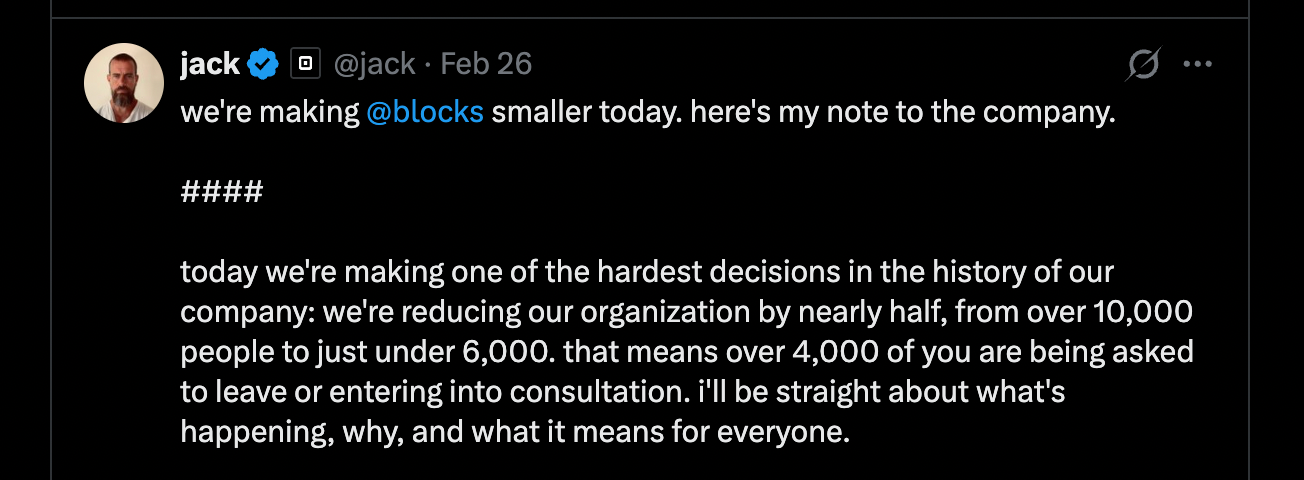
Block — the company behind Square and Cash App — was cutting its workforce by 40%. The reason, Dorsey said, was AI.
‘Intelligence tools have changed what it means to build and run a company,’ he wrote in a letter to shareholders. ‘A significantly smaller team, using the tools we're building, can do more and do it better.’
In a company memo, he reportedly distilled it further: ‘100 people + AI = 1,000 people.’
Dorsey predicted that most companies would reach the same conclusion within a year. ‘I'd rather get there honestly and on our own terms,’ he wrote, "than be forced into it reactively.’
Some argued that Dorsey was using AI as an excuse for layoffs that needed to happen anyway, to correct for overhiring during the pandemic. Dorsey pushed back against those claims.
In any case, within weeks reports emerged that Meta was preparing a similar move: a 20 per cent headcount reduction tied to AI capabilities. Salesforce had already cut thousands of customer support roles and replaced them with AI agents. Shopify's CEO told employees that teams must prove a job can't be done by AI before they're allowed to hire a human.
The conversation around AI and knowledge work has shifted, and fast. That conversation, now, is about a shift from AI as tool to AI as worker: an autonomous agent that does the job itself.
And in some boardrooms, executives are already arriving at something even more radical: AI as organisation. The idea that an entire company can be restructured around machine intelligence, with a small residual human workforce overseeing the process.
Microsoft's AI chief, Mustafa Suleyman, recently warned that white-collar workers have a year to eighteen months before they face widespread displacement. Andrew Yang and Jamie Dimon have said broadly the same thing.
We should take every announcement of ‘layoffs because of AI’ with a grain of salt. And we should be wary of overclaims when it comes to the real capability of AI agents. Still, the narrative now in play — a narrative about autonomous workers or even autonomous organisations — is supported by hard evidence on the accelerating capability of AI.
The direction of travel is pretty clear:
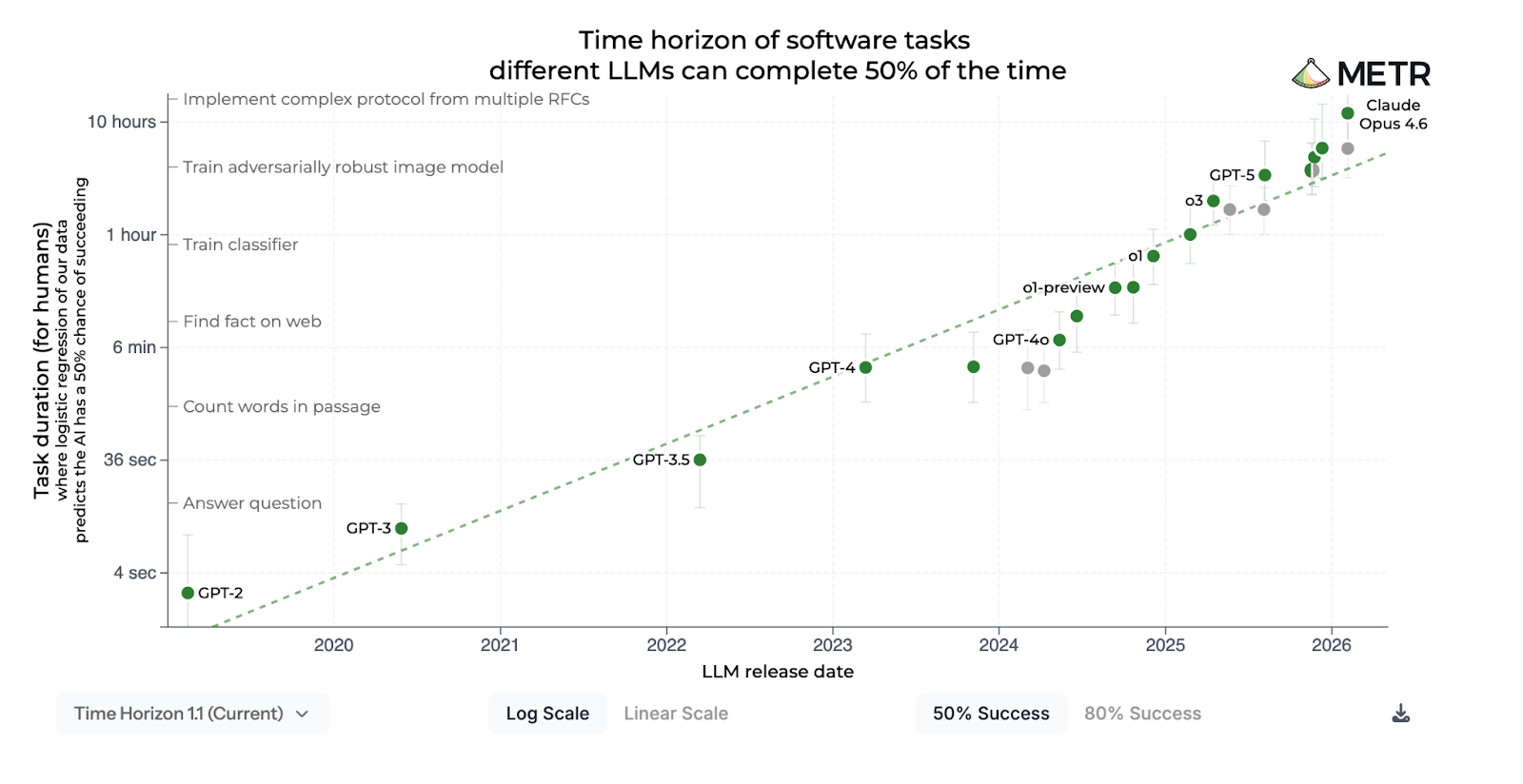
And what I’m interested in here is: what does this shift mean for brands?
When you see all this in light of the Glass Box idea, you’re thrown on a deeper set of questions. Remember, the fundamental Glass Box insight is that in an age of transparency, internal culture is a crucial part of public-facing brand.
So in the age of the AI agent, the question now becomes: what happens to internal culture — and by extension, what happens to brand — when you replace the people inside your organisation with intelligent machines?
We're not just talking, here, about individual brand decisions. We're talking about the conditions under which brand itself — as a phenomenon, as a source of meaning and connection — survives or dies in the age of AI.
People Mediate Brand for People
To answer that question, we need to go back to the Glass Box and draw out an implication that I didn't fully articulate at the time.
When internal culture becomes part of brand, something else happens. The people inside an organisation became a necessary mediating layer between the consumer and the brand. They became, that is, the substrate through which brand comes alive.
Let me unpack what I mean by that, because this is the crux of everything.
In the age of the Glass Box, a brand is more than just a message transmitted from a company to an audience. It's more than the latest campaign, or a series of LinkedIn posts ghostwritten for the CEO. A brand is something that comes into existence when human beings inside an organisation live it. When they feel it, care about it, and go to work animated by it. And, crucially, when people outside the organisation perceive that this is happening. The consumer experiences the brand through the people inside.
Think about one of the world’s most iconic brands: Nike.
The Nike brand depends on me believing that inside that organisation there are human beings who live and breathe the celebration of sporting excellence as a path to human transcendence. People who came to Nike, and stay there, because they are excited by that idea. Who argue in meetings about how Nike should manifest it into the world.
That belief — that perception of what Mark in a previous essay called human intent — is not incidental to the brand. It is the brand.
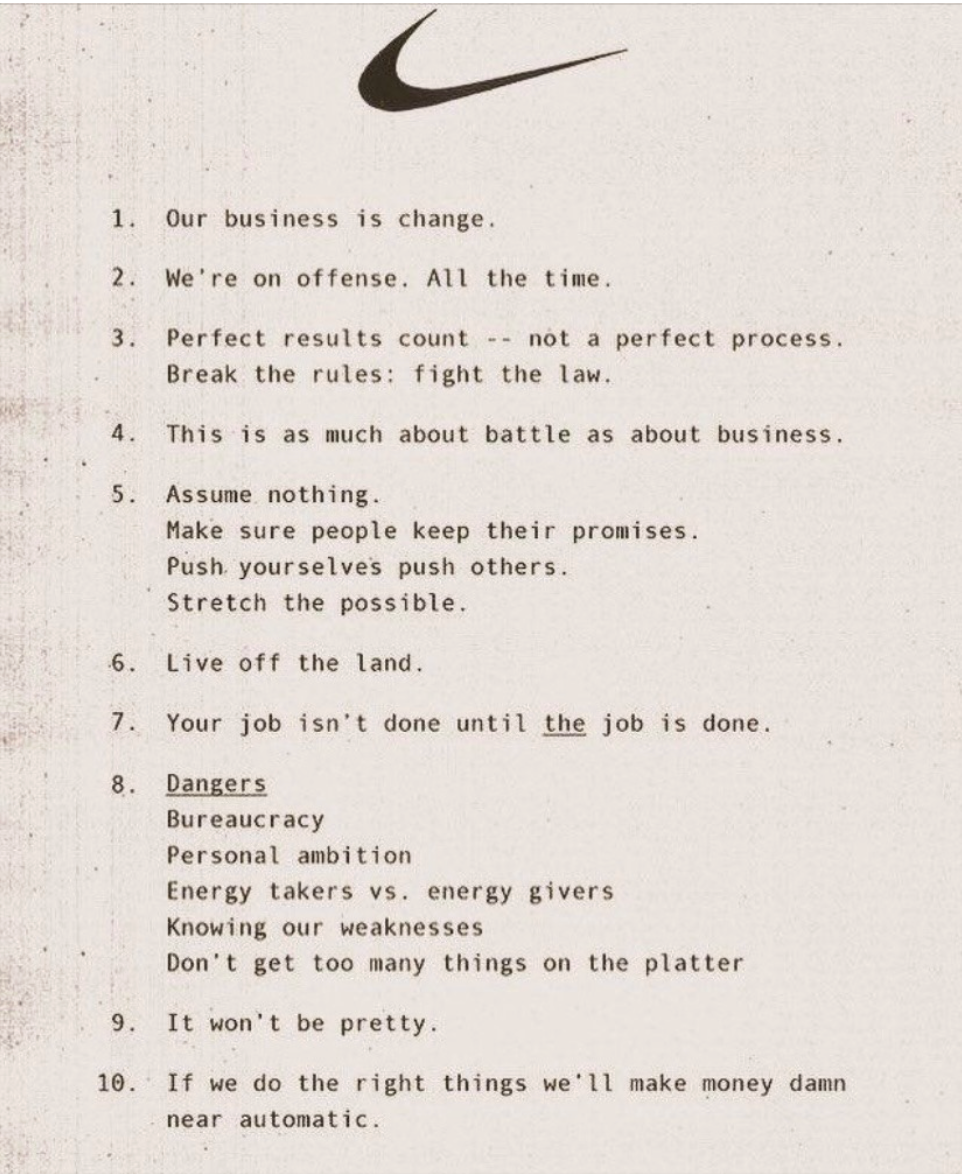
That’s what makes, for example, this iconic early statement of operating principles inside Nike such a cool piece of brand lore. These principles were written by the marketing and management leader Rob Strasser, one of Nike’s first and most influential senior executives.
None of them are about the celebration of sport. They’re even explicit about commercial imperatives: we want to make money. But they also convey something deeper. That is, they convey: here are a bunch of people who cared acutely. Here is passion. Here is human intent. That’s why they are so electric.
Now let’s do a thought experiment. Imagine a Nike staffed almost entirely by AI agents.
The swoosh is still there. The products are still there, and maybe they are even better engineered, and more precisely optimised around performance metrics. The ads are still brilliant — at least, superficially so — and they still celebrate sporting excellence. But there are no people inside the organisation to feel anything about all this. That is, there is no one living the brand. Where the people once were, there are now only AI agents: silent, unfeeling, algorithmic.
And, crucially, via a more transparent world, consumers know this. They know that Nike as an organisation is mostly staffed by AI agents now.
In this thought experiment, the glass box is empty. The lights are on but nobody's home. And what that means is that the layer of human intent is gone. The layer that mediated the brand for me, the consumer, is gone. And in this way, the brand dies.
AI agents could churn out a ‘Ten Maxims’ manifesto, much like the one written by Rob Strasser. But it would be devoid of any emotional resonance. Consumers might end up reading it, eventually. But they wouldn’t feel anything about it.
You could extend this to almost any brand that trades on meaning rather than pure utility.
Patagonia's brand depends on me believing that the people inside genuinely care about the planet. Apple's brand depends on me believing that at the heart of this organisation are people still obsessed by the collision of computers and human creativity.
Any number of craft beer brands depend on the idea that the people inside that brand care about local authenticity.
Strip away the humans and you strip away the caring; you strip away the intent. And without that intent, what remains is only product; the emotional resonance is gone.
It amounts to this: human intent is the animating force of brand. It is what separates a living brand from a logo stamped on a product. For brand to have emotional resonance — for it to mean something — there must be a charge of human feeling running through the organisation and out into the world. The people inside must care, and, crucially, the people outside must perceive that they care.
I can hear the counterargument forming. It goes something like this.
Won’t AI agents be able to simulate internal culture convincingly enough that the mediating layer still works? After all, they can post warm and fuzzy content about the organisation on social media. They can generate mission statements and internal communications, and soon enough that content will be indistinguishable from the work that a team of talented humans would produce. From the outside, looking through the glass, wouldn't it all look the same?
Maybe, for a while.
But that won’t be sustainable. The Glass Box understanding of brands, remember, was always a story about transparency. The same radical transparency that turned internal culture into brand will, in time, expose the absence of any human-created culture. AI-generated culture might fool some people for a bit. But the illusion will only hold as long as no one looks too closely.
In a glass box world, people will look. And they’ll see that the glass box is now empty. Or, more specifically, that it contains only robots. The human intent has gone.
We already have a case study of sorts. Klarna, the Swedish fintech, loudly celebrated replacing 700 customer service agents with AI. Then customer satisfaction plummeted, and complaints surged. Users said the AI-generated responses were generic at best, and useless or plain wrong at worst. Klarna ended up rehiring humans. The initial impetus for those rehires was functional; AI agents simply weren’t doing a great job. But there was a deeper imperative at work, too. Klarna was damaging its brand. It was shredding its mediating layer.
We can take that lesson, and apply it to a million different kinds of organisation. When people discover that the passionate LinkedIn posts are machine-generated, that the company values were written by an algorithm, that the inspirational CEO updates are composed by an AI trained on past inspirational CEO updates, their perception of the brand simply cannot remain the same. It’s absurd to think it will.
And this is a problem, I think, that many organisations are going to have to contend with in the years ahead. What happens to your brand when you replace people — real humans, who have intent — with robots who feel nothing?
If you’re involved in the creation, nurturing, or communication of a brand, it’s worth taking that question back to your team today.
Ask some core questions:
- How does the human intent of those inside our organisation shape the consumer experience of our brand? What is it that people understand us to believe? How does that shape their beliefs about us?
- What happens to that mediating layer, and what happens to our brand, as this organisation reshapes itself around AI?
- How do we ensure that human intent — that the mediating layer of our brand — does not get destroyed?
This all taps into one of the deepest truths about the coming age of intelligent machines; a truth I find myself repeating over and again in different contexts.
Yes, intelligent machines will be immensely capable. They’ll be able to write great copy, or design great products. But the one thing they’ll never be able to do? They can never share in our uniquely human way of seeing the world. They can never know what it is to be a human being, living through these times, experiencing them in the way humans do, and feeling something about it all.
Only other people can do that with us. And for brands, that truth will end up being hugely important.
The implications are many, and we’ll be exploring them for a long time to come. But to bring all this in to land, I want to take a first look at two of the most important.
The Tipping Point
Here is a central caveat when it comes to the argument I’ve made so far: few organisations are going to go 100% AI, or anything close to that. The fully autonomous company staffed entirely by machine agents is, for now at least, an extreme case.
In that case, are all the concerns I’ve written about here overblown? I mean, if an organisation still has some people inside it, then there’s still a mediating layer for the brand, right? There’s still human intent. So everything is fine?
I think the picture is more nuanced than that.
Sure, few organisations will ever be 100% autonomous. But what the extreme case reveals is that there is a tipping point in play here. A threshold beyond which the mediating layer ceases to function and the brand begins to die.
And this threshold is closer than many leaders think.
Crucially, it's not simply a headcount question. You can't just count how many humans remain and conclude that if the number is above some threshold, the brand will continue to thrive.
In a transparent world — in a glass box world — it's about something more subtle. It's about whether the remaining humans are visibly valued, and central to what the organisation is. Or whether they're a residual presence in a company that has made clear it regards people as a cost to be eliminated.
Brands that broadcast contempt or carelessness for the role of human beings — as some CEOs have come dangerously close to doing recently — will damage the mediating layer even if plenty of human staff are left in place. Because what the consumer perceives through the glass is more than just who is inside; it is how the organisation feels about who is inside.
If a company makes clear that it views its people as something of an inconvenience, or a holdover until AI agents are good enough to act as replacements, then the circuit of human intent is already breaking. The mediating layer thins, and the brand starts to die.
So this has deep implications for the way every organisation manages its incorporation of AI agents. It means that getting that process right isn’t just a matter of logistics, workflows, and efficiencies. It’s a matter of protecting the brand, too.
One of the central challenges for so many organisations in the years ahead will be: how do we avail ourselves of the efficiency gains made possible by AI agents, while ensuring that we don’t kill the mediating layer of human intent inside our organisation?
How do we remain human, and therefore preserve the conditions that make a meaningful brand possible, in the age of intelligent machines?
The Polarisation
Having established all of this — the mediating layer, its dependence on human intent, the tipping point — we arrive at a deeper implication.
Medium and long-term, where does all this head?
My answer: towards a polarisation. Two poles are emerging, and the space between them is becoming untenable. That polarisation looks like this:
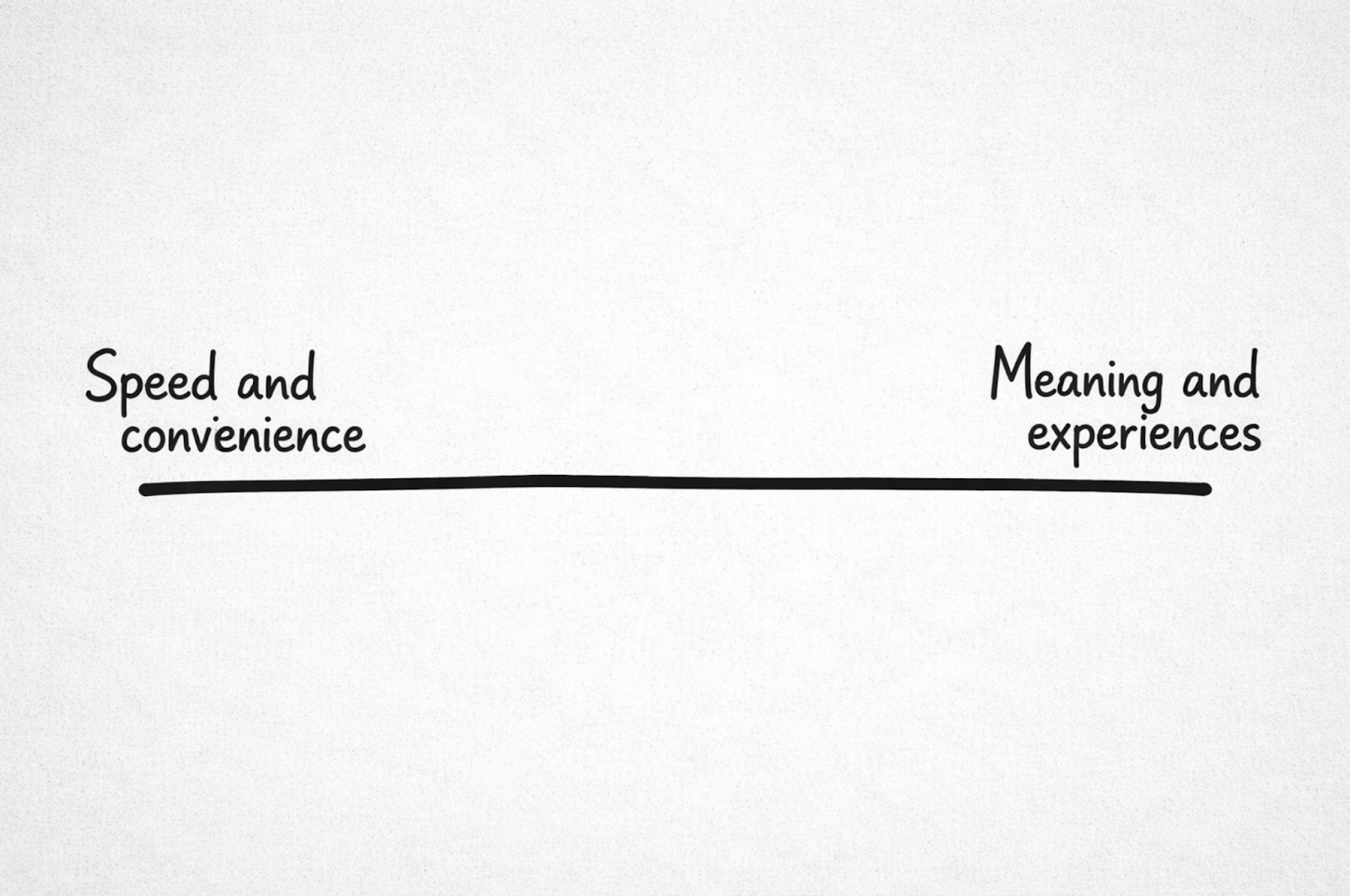
Pole one is about speed and convenience. Organisations that lean fully into AI, strip out human workers, and compete purely on speed, cost, and ease of use. These organisations effectively abandon brand in the traditional sense. They become something akin to utilities. They compete on pure performance: the lowest price, the fastest delivery, the most seamless transaction.
This is a legitimate strategic position. There are vast markets where the consumer wants nothing more than the cheapest, most convenient option and couldn't care less who — or what — is behind it. No one needs to feel emotionally connected to their payment processor.
So if you’re Jack Dorsey’s Block, then this is a viable route for you.
But leaders who choose this path should understand what they are giving up. They're giving up the ability to charge a premium based on emotional connection, and the kind of loyalty that is associated with that connection. They're giving up meaning and human resonance. In exchange, they get a better profit margin. For some businesses, that is the right route. But it is a tradeoff, and all tradeoffs should be undertaken mindfully.
Pole two is about meaning and experiences. Organisations that stay predominantly human and make that humanity their central proposition. They build and demonstrate a culture of living, breathing people who care: and they make that visible through the glass. They invest in craft, mastery, and judgment. They celebrate the humans inside the organisation and make their journey part of the brand's story.
The Accenture Life Trends 2026 looked at a dimension of this via a trend called Good Vibrations, in which it observed that consumers are questing after more authentic in-person experiences. Brands that can provide these kinds of experiences, said the report, will build deeper connections with consumers. They will, to use the language I’ve used here, demonstrate real human intent.
In a world in which rising numbers of organisations shift towards AI agents, brands that can credibly claim human intent will stand out. The more scarce human-centred organisations become, the more differentiated their brand positioning will be.
And the other implication of all this is: it becomes extremely hard to exist somewhere in between these two poles.
You can offer speed and convenience: the appeal of those is obvious. Or, if not, you can offer meaning and amazing experiences; the kind of experiences that make a consumer want to spend more time engaging with you. But if you’re somewhere in between those two poles, then what, exactly, are you offering?
The temptation to try to straddle these two poles will be enormous. Leaders will want the efficiency gains of AI and the emotional premium of human brand simultaneously. Some will try to have both. They'll cut their workforce in half and then run advertising campaigns that celebrate human creativity and passion.
In most cases, it won't work. The glass box will ensure it doesn’t. The same transparency that made internal culture into brand makes it impossible to fake.
These two poles have been in play for a while. The tension between convenience and meaning is one of the deep structural forces shaping consumer behaviour. But my contention, here, is that the arrival of AI agents into a world of Glass Box transparency makes this polarisation acute.
Brands will need to decide where they stand.
Only People
The Glass Box Brands trend was a story about what happens when people can see inside an organisation. The next chapter is a story about what happens when a new kind of organisation becomes possible. One in which there’s no people left to see.
For a decade, the lesson has been clear: internal culture is brand. Now we must confront a deeper truth. If there are no people, then there can be no authentic culture. And if there is no culture, there can be no meaningful brand.
Only people can build brands that other people care about.
This is a strategic reality. But it's also something deeper. It's a statement about what brand has always been, underneath all the frameworks, positioning matrices, and creative briefs. Brand is a human phenomenon. It is born in the space between people: those who make, and those who use. It is sustained by intent. By the irreplaceable fact of human beings who care about something, and share the outputs made by that process of caring with others.
The organisations that understand this — that recognise human beings not as a cost to be optimised away but as the irreplaceable animating force of brand meaning — will build a new kind of moat in the age of intelligent machines. A moat, that is, based on human feelings.
Everyone else will have to compete on speed, convenience, and, most of all, price. And in a world of AI-driven efficiency, the price will always be falling. In many industries, that will be a difficult place to be.
It will take leaders with courage to apply these insights.
It’s easy to explain to your board, or the markets, why you’re cutting staff costs by shifting to AI. Profits will rise. The quarterly numbers will look great. Investors will be happy. It’s harder to explain that you are investing in people because they are the mediating layer of your brand — they are what make the brand live — and that the brand, in turn, is the basis of your price differentiation.
But if you believe in brand, and if you are a person involved in the creation of brand, then this is the argument you’re going to need to make in the years to come. Armour yourself; it’s going to be tough out there. But the battle will be worth it.
I’ll keep watching.
The cover illustration is by Harriet Yakub.
Harriet looks at the world through an honest yet playful lens. When creating she asks herself the question 'Why are we?’
Rooted in compassion, relationships and humour, Harriet creates a visual world for everyday people, exposing all of our everyday secrets and experiences. Her work is expressive and bold, playful, and rich with personality, combining simple forms with hand-drawn textures for a distinct and contemporary feel.
Based in Dublin, Ireland.
Read Next


Conservation Projects
Everything is getting weird. How should brands respond?

Is AI stretching your people?
Guest essay

Sign up for our webinar on how AI is changing Design
Event series
Comments