

Customer Love is Rarer Than You Think


How many times have you heard a company executive claim that customers just love their brand? Every company making consumer goods and services wants to believe it. Evidence appears to be rich – anecdotes of everyday people encountered who rave about the brand in question are bolstered by sales figures which appear to back this up. If that’s not enough, check your social feeds – millions of followers attest their affection by their sheer virtual presence and likes.
But what if we are kidding ourselves? What if there are neurological limits to the amount of brands we can genuinely love at any one time? In which case what’s the number? And is there space for my brand?
Tesco (a UK supermarket) typically carries 40,000 product lines or SKUs, which actually reduce down to 4,000-5,000 unique commercial brands. Of course there are Tesco own brand products as well which can be 40-50% of the store. In the US, Walmart typically has over 120,000 SKUs, which compresses to roughly 6,000 – 8,000 commercial brands. Walmart also has a plethora of phantom own brands too.

Yet customers in both stores average out at 40-50 items purchased on each weekly visit. Usually these are pretty much the same items.
Now of course, it would be silly to claim that consumers love every brand they buy on that weekly shop. The point is that we are confronted on a daily basis with incredible levels of choice, and we cannot process all of it into relationships. And yet, deep down, in the middle of the night, every brand fervently hopes to be loved.
There is a massive asymmetry at work here. Brand owners (especially their marketing teams) spend 40+ hours a week thinking about nothing else than their brand. Consumers spend much less than a second in most cases – if the brand is lucky.
Are there more realistic ways to think about the relationship between a product and a human? In this essay I'm going to explore the real nature of brand love: what it is, and is not. I'm going to delineate four types of relationship that consumers have with brands measured against love and time. And argue that the number of brands a consumer can *love* is limited to a surprisingly small number – and that this space is ripe for colonisation by AI driven brands.
The Dunbar Number
In 1992 Robin Dunbar, a British anthropologist, first posited his now famous Dunbar number.
His research was originally done on primates - by comparing primate brain sizes to their average grooming groups. A year later he extended it to humans. He suggested a theoretical cognitive limit to the number of stable social relationships a human can maintain. A "stable relationship" means you know who the person is and how they relate to you socially.

Dunbar found a direct correlation between primate brain size (specifically the neocortex) and the size of their social groups. Extrapolating this to humans, he concluded our mental bandwidth caps our casual social network at roughly 150 people.
His team looked at both historical and modern day evidence. They examined hunter-gatherer societies, traditional farming villages, and historical military units (from the Roman Empire to the modern British Army). They found that across centuries and continents, the baseline size for a cohesive, self-governing community consistently hovered between 100 and 200 people.
They also tracked modern networks across different cultures using census data, church congregations, and communication logs (like a Christmas card study).
No matter the culture or geographical location, when a group grows past roughly 150 people, it naturally begins to fracture or require formal, hierarchical rules to stay together. Why? Because people can no longer track everyone else's social status based on personal relationships alone.
A lot of people are aware of the 150 number. There are others. They come in concentric circles of intimacy.
5 people are the innermost core. These are our most deeply loved ones – people for whom we provide intense emotional support and expect it back.
15 people are the sympathy group – these are close friends we trust deeply.
50 people are our frequent acquaintances.
150 people are casual friends – people we call friends and are within the outer limit of stable relationships that can be handled at any one time in our lives.
There is one more, which is less precise - a 1,500-person Ring, defined as faces you can put a name to. This has been supported by subsequent research that shows the upper limit might go up to 3,000 or more. There does appear to be an absolute cap but it gets pretty blurry as to where. For our purposes, it does not really matter.
As you can guess, I am about to apply this to brands, but before we do so it is fair to acknowledge that Dunbar’s analysis, despite widespread acceptance and proof points, does have its critics. These focus on methodology (academics love this angle of attack) and on looseness of definition – what is for example a “stable relationship”? Hold that thought. Lastly the power of culture and technology: critics argue human sociality is governed by cultural norms, language, and technology - not just brain physiology. Essentially, digital media now acts as "cognitive scaffolding," allowing humans to maintain vastly larger or more complex networks than our ancestors.
What matters here is not exact numbers – though I’d argue it is not hard to instinctively recognise these in our lives – but the baseline macro observation - the fundamental concept of cognitive limits and concentric layers of emotional intimacy remains undisputed.
There is no question that social media has affected the numbers - at the top level. When The Pew Centre looked at the average Facebook friend count there was a split depending on whether you look at the mathematical mean or the median. The Median comes out at 200 friends - meaning half of all users have more than 200, half have fewer). The Mean (average): is 338 friends. This number is pulled higher because of "power users" who have thousands of friends, skewing the mathematical average upward.
Robin Dunbar himself studied active behaviour on Facebook and showed that even though the average person has 155 to 338 friends in their digital network, users consider only about 28% of their Facebook friends to be "genuine or close." When surveyed, the average user admits they would only trust 4 of those friends in a true crisis. As he said “Social media sites tend not to differentiate between close and distant relationships, but the human brain clearly does”.
Brands, and the Dunbar Map
This model surely applies to brands too. Why? If we only have room in our heads for a fixed number of relationships with other humans there must be constraining factors. Now here I am guessing, but those could be cognitive bandwidth (how many relationships I can process in any meaningful way) and real bandwidth (time we can spend with people). The same must be true about brands. If so, we can now create a simple model to think about how consumers relate to different brands.
Let’s get back to the love word. As critics of Dunbar point out, definition is loose, in fact hard. So when I use the word love from now on around brands, I am really talking about emotional connection, or quality of relationship – something we might express loosely as love. When I ask people (and I do) which brands they truly love no-one mistakes the category as the same as love for another human. It’s just an indicator of strength of feeling. It's about feeling an attachment to *this* brand in particular, beyond only the product or service benefits it provides. And that kind of feeling comes about probably in two big ways: either because you believe that *this* brand in particular provides the product or service benefit brilliantly well in a way no one else could (say Apple as a classic example), or you believe in the values and vibes of the brand (say Patagonia).
Dunbar thought of concentric circles. I prefer to think of this as a matrix (twelve years at Accenture does this to you). Let’s use the constraining factors as axes. But I am going to simplify them – the vertical Y axis is emotional connection with the brand (non-existent at the bottom, strong at the top) and the horizontal X axis is time spent with the brand. It looks like this.
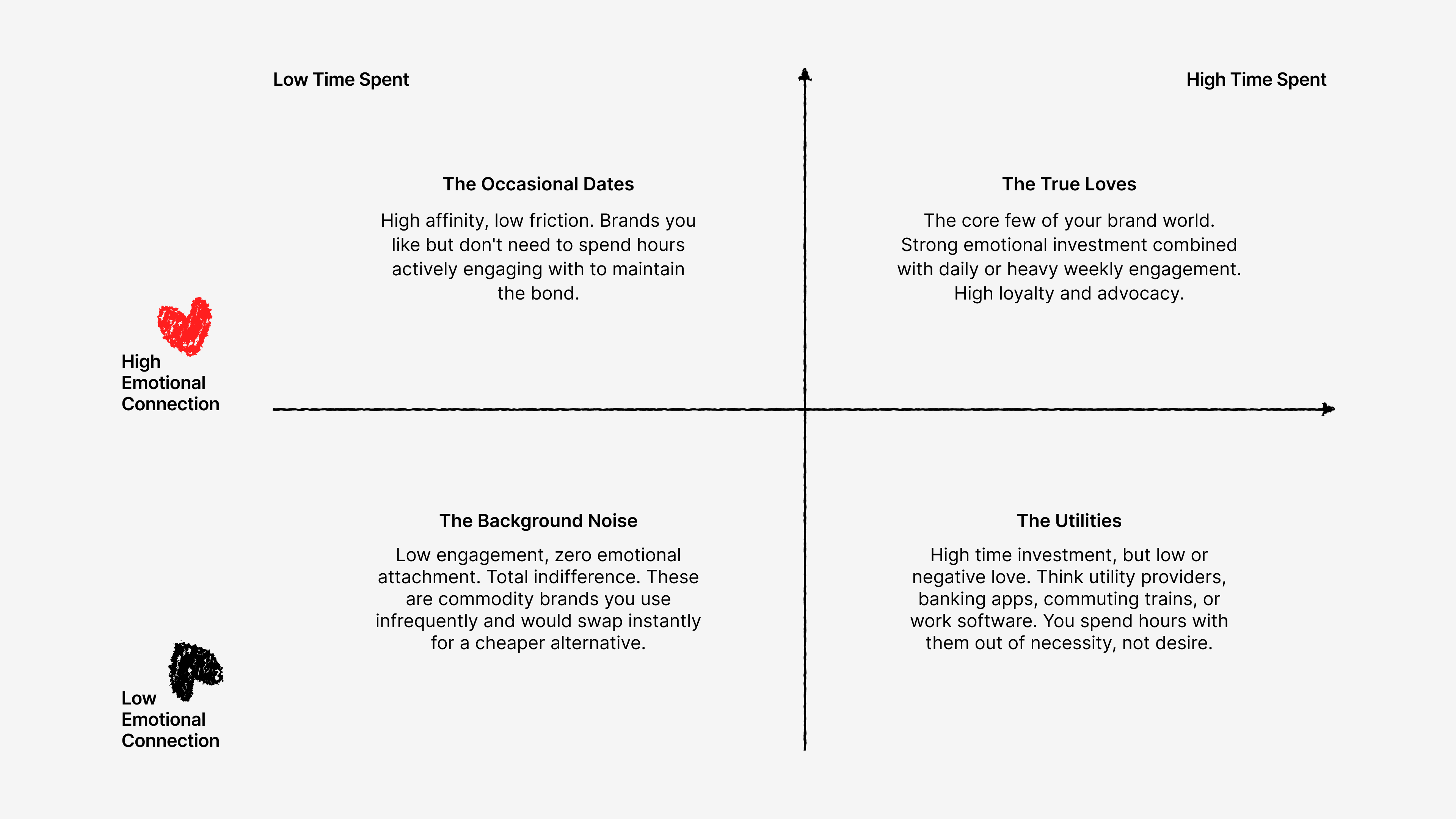
Let’s look at each of these in turn, and what strategies you can use to move your brand around the map. I am going to use personal examples but not exhaustively. Heads up - everyone’s Dunbar Map (my terminology) is going to be different, and I will return to that issue when I consider AI.
The True Loves
What brands if they disappeared or went bust tomorrow, would you truly miss, maybe grieve for, for a while at least? They belong here. For me personally, Spotify is the exemplar. I love music and use it several hours each day, I have hundreds of playlists on it, share with friends and increasingly it’s a source of concert ticket alerts. I’ve invested meaningful time in the relationship. I’d be hugely upset if it went away.
I have tried really hard over the last few days to think of products and services that fit in this quadrant. I got to seven. I suspect somewhere around ten is my limit. Over the last decade I’ve used this map in multiple workshops – and challenged clients to fill this quadrant. The one rule was that they could not name their own brands! No-one has ever got beyond ten.
For marketeers it is a pretty humbling insight. Getting into this golden zone – where surely profit and volume lie, is very very hard because it is a finite space. So if some other product gets in there, your brand might drop out. Conversely, you are going to have to elbow some other brand out of our rare relationship bandwidth – both in time and affection. This is not abundance. My unscientific guess at a limit of ten sits precisely between Dunbar's absolute inner core of relationships (5) and his total sympathy group (15).
The Utilities
What do you use frequently but don’t feel any sentiment for? Your electricity provider? That train company? Maybe a discount airline. For me, Microsoft is in there. I am using Word right now to write this but I don’t love it nor its maker. That might feel unfair – like I am taking it for granted (just like someone in your broader work circle?) yet it is reality. It is really useful, on a daily basis, but it turns out that frequency and utility are not reliable predictors of affection.
In some ways, this is the hardest quadrant to evolve within or from. A lot of brands that fall in here are largely invisible services (telcos, energy, banks) or commoditised products (toothpaste, sanitary products, milk). As I have said before on Full Moon, Octopus Energy are an example of a UK brand that has managed the trick of moving upwards towards being more loved. One way they do this is by simply being more visible – their app is both more useful and more attractive, and they run a tight and friendly CRM programme. As a result customers engage more often Octopus, which both moves them rightwards along the time axis, and builds the relationship upwards.
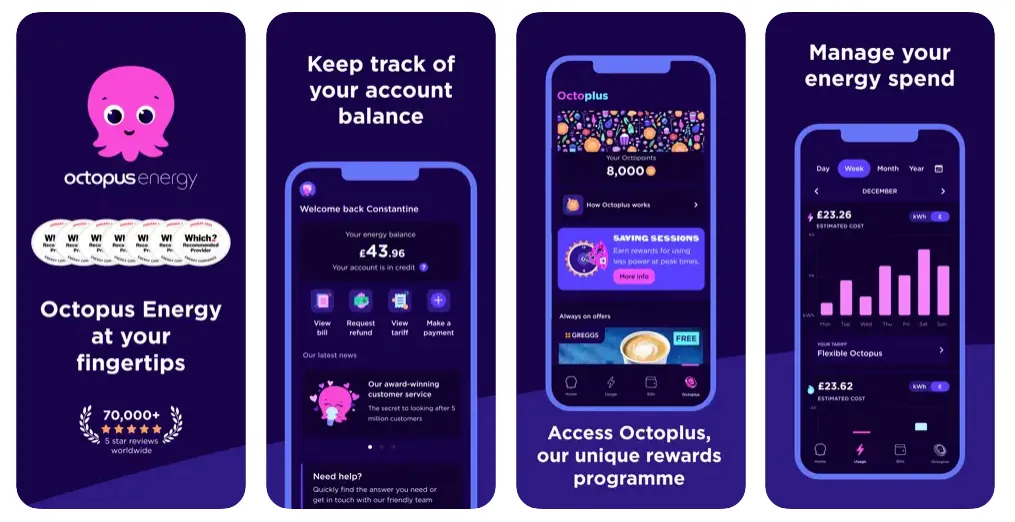
Neobanks Monzo and Revolut have famously also invested in better app and service design, and a challenger brand position. Customers open their apps between 30-50 times a month. Compare that with traditional UK banks for whom the comparative stat is 10-15. A bank may never make it to the top right hand corner, but they can nudge their way towards it.
The overall strategy for all of the above was elevating the experience, and humanising something manila.
Another approach is community and shared identity. Strava is a good example. It’s really just a GPS utility app that tracks numbers - a digital stopwatch. But by adding a social layer (giving "kudos," sharing routes, local leaderboards), they transformed it into a global community of athletes. People don't just use Strava; they say they are “on Strava."
The Occasional Dates
If Dunbar’s map applies here – then there is a wider circle of brands that you really like, maybe love, but cannot spend so much time with, for a few reasons. I love a gin called Silent Pool, but its not good for my health to spend too much time with it! Not coincidentally, it is pretty pricey too. The best airline I have ever flown is Virgin Atlantic, but my last employer didn’t like their pricing too much, so I was infrequent. I like Eurostar (a train that goes to Paris from London) because of all the rich expectation of that journey, but I don’t make the journey too often. These are natural constraints of everyday life. How many brands can exist here? It is probably somewhere between 50 – 150 (Dunbar’s ‘frequent acquaintances’ and ‘casual friends’). Important to acknowledge that frequency for brand relationships has a different scaling to human relationships. The cadences are not exactly the same.
Brands in this quadrant are likely to be purchases or usage that lie outside the everyday. The strategy for this quadrant is to move right - to become more frequent. This however is risky. Urban hospitality franchises, if successful, always try to grow through new outlets even though they know that ubiquity tends to lessen aspects of brand love unless you are very very careful and maintain a tight grip on quality. Occasional Dates is a tightrope sector where image matters a great deal.
If a brand sits here, the goal isn't just a reckless sprint for volume. The best approach should be about maximizing the premium nature of every interaction. Because time is limited, the brand must ensure that every single "date" delivers an unmatched, flawless experience that justifies its premium price or scarcity. It’s about depth of transaction over frequency.
The Background Noise
Put simply, this is where the (probably) thousands of brands you are aware of, but don’t care about at all exist. The numbers in this quadrant are going to vary the most from person to person – it would be tedious to try to count, but go ahead if you want to give us feedback. Remember you see thousands just in the supermarket, let alone through advertising. Over time, those stack up.
Most of them we will never buy. Or may have moved on from. We are just aware they exist. Corn Flakes are a personal example. I liked them briefly a long time ago but for reasons of taste and health they are not in my repertoire any longer. But I know they are there. Other examples I buy infrequently if I have to. There are brand categories I just don’t care about like lightbulbs or batteries. I don’t buy them that often but probably veer towards brand recognition when I do. It’s not love that’s for sure.
Walmart represents the absolute zenith of the Background Noise quadrant. A consumer is physically walking through a landscape of roughly 140,000 choices, entirely surrounded by thousands of brands they ignore.
Despite being exposed to this unmatched sea of abundance, the average American household still buys mainly the exact same 40-50 items over the course of an entire year (the totals come to more like 300-400 but the differences are small variations each week which tot up over time). Some of these will be Occasionals, some Background Noise choices.
Even when a retail monolith builds a cathedral to infinite variety, the human brain enforces its own Dunbar cognitive boundary. We plug our ears to 99.9%, treating Walmart or Tesco itself as giant, faceless Utilities that we use simply to access our tiny, carefully guarded inner circle of True Loves and some Background Noise we do not really care about and could swap out from with no emotional friction.
Being in this quadrant is not a prison sentence. The whole point of what I call the Dunbar Map is that there is a highly limited number of brands that can make it to the top half of the matrix where love resides. It is better to get realistic about that and plan around it.
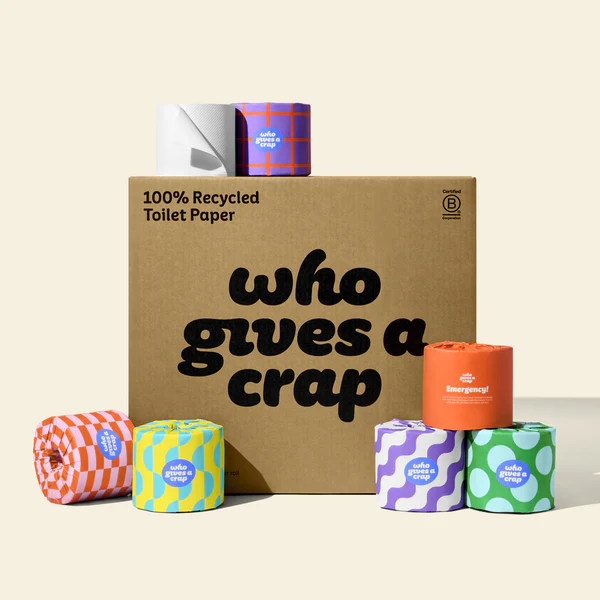
Some categories of product and service have in built qualities or context of use that make their destination likely - but not inevitable. Who Gives A Crap toilet paper is a good example. Great brand name with a story (it gives money to sustainable causes), which lifts them out of commodity towards love. Not a lot, but enough to drive success.
Why does the Dunbar Map matter?
If it is not evident already – this is a strategic customer map. As I said earlier, of course everyone’s map is unique to themselves. Yet they aggregate together. You can’t be a True Love for everyone, but if enough people put you in that category you have a profitable market.
It provides direction too. As I demonstrated above, movement about the map is a strategy in itself, or might demonstrate a lack of one. Where realistically can your brand be? Where is it now? How, like Octopus, can you move it? Two weeks ago I wrote about the way Jaguar and Ferrari are managing the shift to electric. Jaguar clearly feel they had dropped below the half way point on the love axis. Ferrari risk dropping the other way and looking like a commodity EV.
In the 1990s Pine and Gilmour published their very influential ‘the Experience Economy’ where they pointed out that there are five levels of economic value.
Commodity – abundant, lowest value. Think coffee beans.
Product - brand promises align with a synthesis of commodities – think Nescafe.
Service – value is added by assistance – think cup of coffee in a restaurant.
Experience – the product and service are packaged into something greater than the parts – think barista coffee bar.
Transformation – where all of the above genuinely change your life in some small or big way.
As you go up the scale, value rises - and in theory profit and relationship. Each level is rarer. There are many more commodities than transformative products.
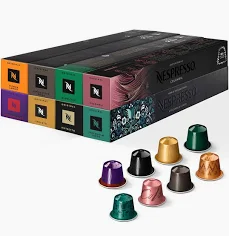
This fits with the Dunbar Map. If you want to move towards another quadrant, or at least to a higher value zone than the one you map to, consider how you can move from product to service, or experience to transformation. It is exactly what Starbucks and Nespresso did. Both brands decided to deliver coffee experiences – one in the hospitality environment, the other at home. In this way they became much more valuable than simply a coffee shop service or retail brand.
To be clear - of course the map is not the real world, which is way more nuanced than I have been pretending here. It is only a strategic guidance mechanism for driving out new thinking, and grounding ourselves in the fact that real customer love is very rare. Once we grasp that, decisions can be more clear eyed. It is not real, and yet helps us grasp reality.
And now, AI
The Dunbar Matrix becomes even more important in the promised age of hyper personalisation. I’ve twice said that everyone’s map is different. That’s a scaling problem for any brand trying to establish where they sit, and how to react.
Already its observable that digital services shook up the map, due to both their physical proximity to humans (in your hand or pocket a lot of the time), and frequency of use (e.g.: banking apps, social media). These two factors give a big relationship building advantage to digital brands, which have elbowed physical brands out of the way over the last 15 or so years. I suspect most people’s True Loves now contain two or more digital products, like Spotify, or now Claude.
And AI changes this equation in two ways.
Firstly, if – a big if – LLMs start to act as gatekeepers to our consumption they are going to learn very fast what our personal maps are. This gives incredible marketing power to those platforms and the potential for brands to customise how they communicate with users based on their love rating.
Secondly the power of relational chat (which is where Open AI initially focussed) is incredibly strong. It gives a crowbar to brands that want to get into that golden quadrant. Take the Whoop device. You talk to the coach daily and it guides exercise. I get that is not for everyone, but Whoop has probably moved into my loved brands zone and is pushing something else out like a cuckoo chick. You may not like fitness trackers, but the likelihood is somewhere an AI is under development that appeals to you so much you will use it often, and ‘love’ what it does. What’s your whoop?
In Sonnet 116, Shakespeare tackles the relationship between Love and Time directly —the two axes of the map.
"Love's not Time's fool, though rosy lips and cheeks
Within his bending sickle's compass come;
Love alters not with his brief hours and weeks,
But bears it out even to the edge of doom."
In the modern digital landscape, algorithms try to treat the consumer strictly as "Time's fool" - measuring screen time, tracking app opens, and confusing a user's captive hours for actual loyalty. But the Dunbar Map proves that time alone is a false metric. While time can be bought, measured, and optimised, true brand devotion is completely decoupled from the ticking clock. A brand can capture our hours and remain a cold utility; but the rare few that touch our identity don't just fill our "brief hours and weeks" - they define them. If AI can identify this, persuasively – it is transformative.
AND A REMINDER!
We're kicking off a new research project on AI and design. Over the next few weeks we'll be having group conversations with designers about how AI is actually affecting their work.
We'll pull together what we learn into a Full Moon essay in August, then in September we're hosting a webinar where we'll share the findings and get a group of designers together to talk about it.
If you'd like to take part in one of the conversations, please sign up via the link below and we will be in touch.
https://tally.so/r/obxelN
Read Next

Conservation Projects
Everything is getting weird. How should brands respond?

Is AI stretching your people?
Guest essay

Sign up for our webinar on how AI is changing Design
Event series

How is AI changing design?
Part III
Comments