

How is AI changing Design?
Part II

Consequences....who is holding the tools?

Everything looks the same
We touched on this in Part One on ‘the words in between’.
Wolfgang supplied the best image for it. Germany, he explained, has a facial cream whose advertising features women who all look identical, and the phrase has stuck. "We call these women nivea women because they all look the same. They're blonde, have a beautiful face. They're all the same. They're just beautiful. Okay. That's it. It's a nivea woman. I don't care about these." Websites, in his view, are heading the same way. Daljit has two formulations, one of which he says he has been using for two decades — "the flattening of design" — and one of which is newer: "the democratization of mediocrity."
Lucia made an argument as a consumer rather than as a practitioner. "I've never been more bored," she said. "If you go to look for clothes, fashion looks all the same, all the girls are wearing the same, everything on Instagram looks the same. Yes, you have infinite choices, but the more and more the choices look the same." Abundance, on her account, is producing boredom rather than delight, which is not what anybody promised.
The most interesting version came from George, who thinks the AI aesthetic has now detached itself from AI creation altogether. He can spot a generated landing page, he said — "or even if it isn't, but it has that sort of look." Work might now be penalised for a resemblance to AI generation. There is a new house style loose in the world, and you can be convicted of using it without having gone anywhere near the tool, which is a brand new problem for anyone whose living depends on visual distinctiveness.
We called this "mehdiocrity" in Accenture Life Trends a couple of years ago and the observation stands, though the mechanism has evolved. What we described was both cultural risk aversion and a probabilistic system regressing towards its own mean. What our research now suggests is that a good deal of the convergence comes through the prompt rather than through the model, for the reasons set out above. If the input is a shared vocabulary, the output will be a shared aesthetic.
It would be convenient to lay all of this at AI's door, and Nick was right to point out that doing so would be historically illiterate.
"Remember Kai's Power Tools and all those filter things when Photoshop first started. We used to have all those crazy organic shapes, and then it became about essentially economization and reuse and speed. We kind of lost the whimsy."
Homogenisation arrived with Photoshop, and then again with the template, and again with the design system, and again with the component library, each time for the same reason, which is that reuse is cheaper than invention. AI is simply the most powerful reuse engine ever constructed, so it accelerates a flattening the profession has already performed on itself several times over, for entirely rational commercial reasons on each occasion.
Insight: sameness is not a new condition and AI did not invent it - but this time a share of it is arriving through the interface rather than the model. Which means it is partly a craft problem rather than purely a technology problem, and craft problems are the kind designers can do something about.
The AI alibi
Which leads to a point made by several people in different countries: that AI is being blamed for a decline that was already some way advanced.
Michal has the clearest version, and he has numbers behind it, because he signs the invoices for ninety or so designers. "The rates on my digital work, which is like the bread and butter of the company, have not increased for last five years," he said, and then, without any particular drama, "I already saw UX dying for quite some time." Five years of flat rates is a commoditisation story that was well underway before anyone in his market had heard of a large language model.
Pushed on what is actually happening in central Europe, he gave an account that connects the commercial picture to something wider:
"The design hype is over. The chief experience officers, in central Europe or even western Europe, I don't see them that often as I used to. Once you feel the geopolitical instability and you feel not sure about yourself, you just default into optimization and not trusting the esoteric nature of design. And then AI comes here, a technocratic approach to the world. That's your solution."
Efficiency – maybe fear - demands optimisation; optimisation produces distrust of anything that resists measurement, which describes a lot of what design actually contributes. Into that distrust arrives a technology that is the purest expression of the technocratic worldview, presenting itself as the answer. Perhaps AI is not the cause of design's difficulty so much as the permission slip for it, arriving just when organisations already wanted to cut, distrusted the immeasurable, and needed a story about why. I find that a considerably more subtle account than the one about robots taking the jobs, not least because there is no amount of skill at using AI that addresses it. It’s been an existential problem for design for years now whenever financial justification is called for.
Wolfgang made a structurally similar argument about Germany from a different direction, describing an economy "built for the boomers" that is now shrinking, with management layers going and automation arriving to cover the gap, and was careful about the causality: "you cannot blame the AI for that. The AI, as with everything we have been discussing so far, is just an acceleration of the trend." Daljit nominated a different culprit altogether, and it is hard to disagree with him: "I think the most evil thing in the world at the moment is the (social media) algorithm. It steals our attention, but more importantly it steals serendipity. The chance to get bored, stumble across something strange, discover something new or have an original thought. I think the algorithm is destroying original thought. I really, really do."
Insight: AI is arriving as the permission slip for decisions organisations had already begun making. That matters practically, because a profession that argues only about the technology will find itself defending against the wrong thing — and losing the argument.
So who holds the pencil?
While the profession has been debating whether AI should design, predictably other people have begun designing with it, and this turned out to be the most substantial theme we spoke about. As a response designers are using AI tools extensively, and engaging in other parts of production, and the work has become more varied, and ‘down in the weeds’ too. But there is massive ambiguity over who is responsible for what.
Matthew was working on a product project where the developer had gone fully in on AI, and the consequence was troubling:
"It was the first project where development was really accelerated by their use of AI, to the point where I sort of felt that he was developing faster not only than I could design but that I could think."
Asked directly whether he had ended up using AI simply to keep pace with the developer, he said yes. And what he did in response is interesting: he moved out of Figma and out of design artefacts altogether, and began producing working demos instead, "as a way of validating my thinking and showing that things could be done". Is that a designer abandoning a design medium for an engineer's medium, not out of curiosity but in order to remain part of the argument? Or is the new medium profession agnostic?
Martin's story goes further. He does interim design leadership, and was brought into a business with one product designer and several hundred engineers in order to establish a service design practice. He lost that argument; nobody wanted the function. So he put AI coding tools into the hands of the operations team instead - business people, working with internal APIs inside a safe sandbox, redesigning what they thought the platform ought to do in order to remove manual effort from their own working lives. It worked well enough that their prototypes began reprioritising engineering backlogs, and their self-serve solutions ended up shifting the product chief's roadmap on a question he had been arguing internally and losing.
"Funny enough that we didn't win the argument to set up service design, but I ended up enabling this ops team to take a service design approach and then use the tools to actually make change."
It is not an isolated case. Matthew watched an executive chairman vibe-coding interactive data visualisations, something the man "would never have thought to do" a year ago. Alex reports clients now arriving at his agency holding AI-generated concepts - "they've AI'd this thing and we think this is what we should go with" - so that a meaningful part of the job has become talking them gently back down, and then, more productively, moving further upstream to help them establish what they were trying to achieve in the first place.
Louis-Jean, who works in French public services, connected a language model to his team's analytics stack over a weekend, and the result was that non-designers in the business deployment department started building and modifying things for themselves.
"They never had as much feeling of control in their work life because they could build stuff themselves."
So this is not about speed or productivity but feeling more in control. Further, people began modifying the application from inside the application itself, "which was at some point possible until my developer colleagues lowered my GitHub privileges."
Tim, who now teaches design at a British university, reports the version of all this that every independent designer fears but may have to grapple with. A fictional but representative client says: "you know what, I'm firing that web design team. I made this myself over the weekend. Is it good?"
That last “is it good?” question is critical, because answering it requires the thing the client plus AI do not have and cannot generate, and it is the only part of the ‘process’ that has not been commoditised.
Nick describes the structural form of it happening on the US West Coast, where the loop appears to have closed already:
"On the PM to designer to developer side, all of those roles are kind of colliding. As a PM, I have a business change that I want to make. I can just run it into a thing and then hand it off to a dev person, and maybe the designer is prettying it up, applying some kind of level of skin to it. But by and large the loop is going across. And so I think there's another fight for relevance."
His explanation for why product managers are winning that fight is that "they are trained to look more broadly than just making a widget, and making the radius look nice on these squared-off boxes."
The shape that emerges from all of this is not yet clear but it’s not a simple displacement nightmare. Other functions have moved into design's chair, and designers have moved into engineering's — out of Figma, into code, into working demos — in order to hold their position in the conversation. At one fast-growing software company Martin described, the design system has been wired directly into the AI workflow, a sales call can become a shipped demo inside two hours, and Figma licences are being withdrawn, not as a cost saving but because the designers themselves have stopped using them.
This is where one of our January predictions needs correcting. We suggested that in theory AI could strip layers of process out of large organisations, with decision-making moving from committee to individual. It was hedged even at the time, and just as well, because what these conversations describe is governance arriving rather than departing - we did not anticipate the cost of tokens. At one company, AI tool requests must now be billed to a case code, which Simon reads not as a restriction but as encouragement; at another firm, per-person allocations, tickets and a spreadsheet tracking who has completed which training; in French public services, a formal rule that no image ships unless finished by a human and no text ships unless proofread by one, justified not on quality grounds but political ones, since it is a poor look for an employment ministry to be seen automating away employment. What actually happened is that decisions moved sideways rather than up or down, into the hands of whoever in the organisation was willing, or allocated, to pick up the tools under new systems of regulation - and that is not always the design team by default.
There is a second correction to make here, and this one I think we got wrong – so far anyway. We argued that design focus would or should move outward, from craft communities towards ecosystem stewardship — design from within becoming design between. The evidence points the other way. Teams are shrinking, and Matthew describes people working in a markedly more isolated way, "because you can touch more parts of the process, inevitably people do, and then you're having fewer conversations with colleagues". What people are reaching for is not the ecosystem but the studio. Ty said he tries to "basically force a studio, even if I can't have that in the environment I'm in". Tim is planning his next academic year around getting a cohort of thirty to behave like a studio rather than thirty individuals at thirty devices, on the grounds that "if we win the project, we all win as a studio". Neither knew the other had said it. At the moment design organisation is trending small and defensive and human-scale, which is the opposite of what we forecast. Duygu on this:
“Mostly we are working virtually and then on top of that the calls are expected to be chop chop. Less community building, sharing of emotions, this is happening in one to one, for the juniors it is more important than ever. I see a growing nostalgia for old ways of working.’
None of this is straightforwardly a loss, and Adrian described a collaborative gain, which is real and possibly larger than the losses:
"I can start having much deeper conversations with my engineering team where before I wouldn't know what to talk about. But here I have a prototype, I understand how the architecture of what I'm trying to do works, and then we can start having conversations that I before wouldn't have felt very comfortable in."
The formulation that the group settled on during that call was that AI had let him talk to colleagues he previously could not talk to, in a language they both understood, and that may prove to be the most durable benefit any of this delivers.
Nathan left a point hanging near the end of one conversation that nobody answered, and it has stayed with me since:
"That might need a few cycles for C-suites and VPs to give it a go and think, you know what, we didn't need to outsource all that stuff. We can do it here and we've got the tools and we've got a designer in the corner."
Insight: the traffic runs both ways. Other functions have moved into design's chair while designers have moved into engineering's medium to keep their seat at the table. The question is no longer whether design survives AI, but what design is for once the artefact is available to everyone.
Part Three to be published on Wednesday 2nd September 2026. Subscribe here to get it sent straight to you - www.wearefullmoon.com
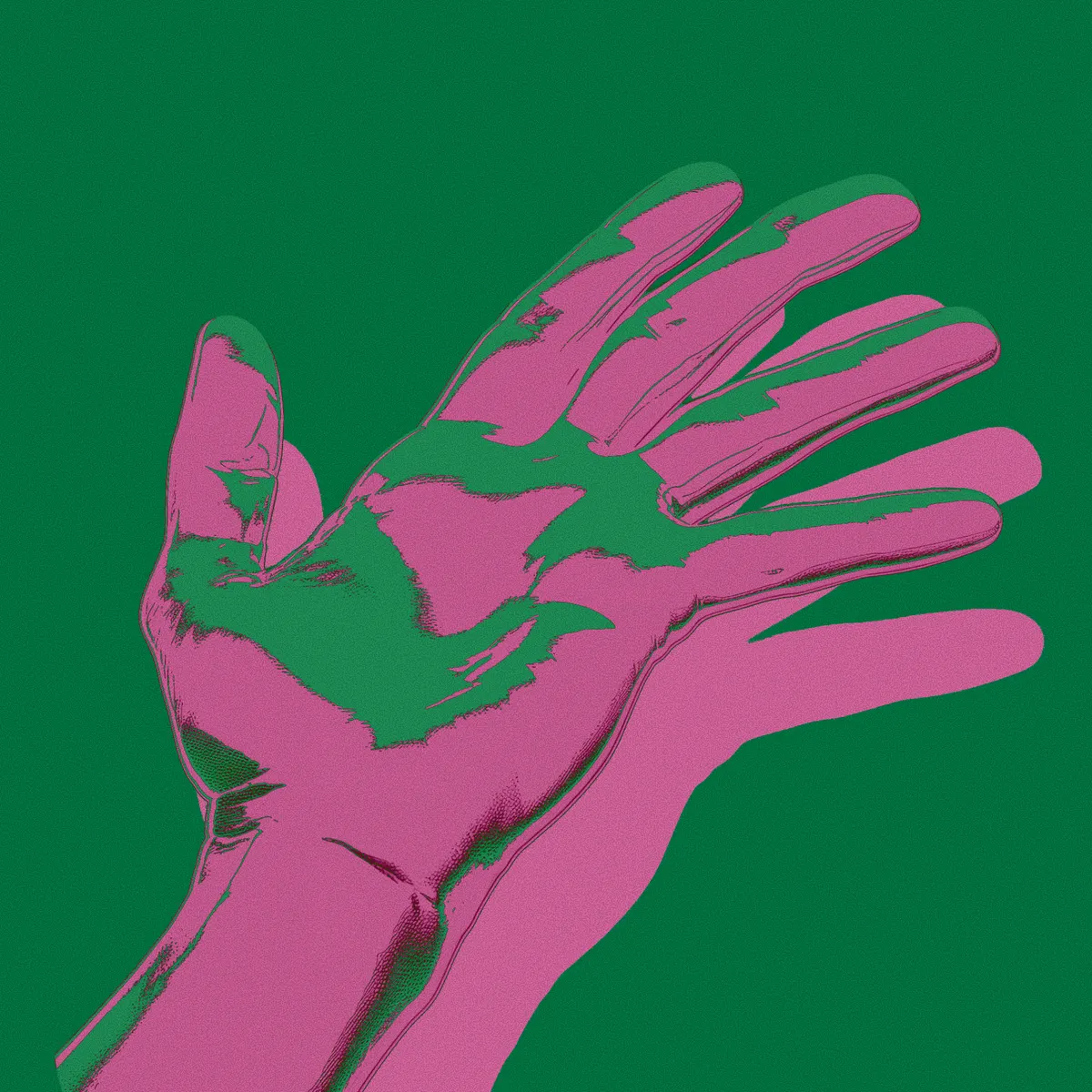
And again I want to pay tribute to Paco's super design idea here - each part is illustrated with a hand playing a well known game. Today its Paper. As he says - ideas, language, thought, communication.
You know where this goes next.
Based on a series of group conversations with practising designers held in July and August 2026. Participants were promised anonymity for their employers; all names are first names only. Roughly half have worked with me at some point over the past twenty-five years, which bought candour and cost distance — read accordingly. Everyone quoted will be joining us for a webinar in September to argue about what it all means. My thanks to all of them. Some quotes have been lightly edited for readability.
Read Next

The Full Moon Podcast
Episode 8 — Conservation Projects and More


Conservation Projects
Everything is getting weird. How should brands respond?

Is AI stretching your people?
Guest essay
Comments