

Always the Real Thing?
What the furore over an iconic ad tells us about the relationship between brands and creative work.

Introduction
I can’t quite believe I’m saying this, but the Christmas season is nearly upon us.
And when I say nearly, I mean from the vantage point of an ordinary person. Inside the world of marketing and brand, we’re already deep into the festivities. The annual Christmas marketing blitz is well underway, and consumers are being hit with a barrage of ammunition intended to persuade them to treat themselves to those 42 bottles of Bucks Fizz, and to get little cousin Theo that copy of GTA 6 that he’s hoping to unwrap (okay, download) on Christmas morning.
So in this monthly update from Full Moon, I want to take the opportunity to reflect on what one of this year’s Christmas ads is trying to tell us. Specifically, what it tells us about the relationship between brands, creativity, and creative people, and how those relationships are set to change.
I’m thinking, here, about one of the most iconic ads in history.
I mean the Coca-Cola Holidays Are Coming ad. A 61-second piece of film that you’ve almost certainly seen hundreds of times, in which a convoy of brightly illuminated Coca-Cola trucks make their way through a snowy landscape and past awed onlookers, while that famous jingle plays.
You know, this…
Across the last few years, the conversation over Holidays Are Coming has become intense.
That’s because in 2024, Coca-Cola released a new version. Remember, the original had played pretty much every year since Christmas 1995. And now, here was an interloper. And the big news was: it was AI-generated.
Given the status of this ad, it’s now being held aloft as the iconic example of what advertising used to be in the Before Times, and what it will become now.
That conversation is fascinating. But it’s been largely based on vibes. Now, we have some hard evidence on how the AI-generated Holidays Are Coming is performing. So I want to take a look at that evidence, and share four thought starters based on that evidence and the early responses to it.
Let’s get into it.
The Evidence
So what does the evidence tell us? First, some context.
When Coca-Cola released the first AI-generated version of Holidays Are Coming back in 2024, the response was immediate and visceral. Across the mainstream and industry press, commentators lined up to point out that consumers were ‘disgusted’ with the new ad.
Coca-Cola repeated their AI-generated Holidays Are Coming last year — with a few minor changes — and they’ve done the same this year. And both times, the backlash has raged:
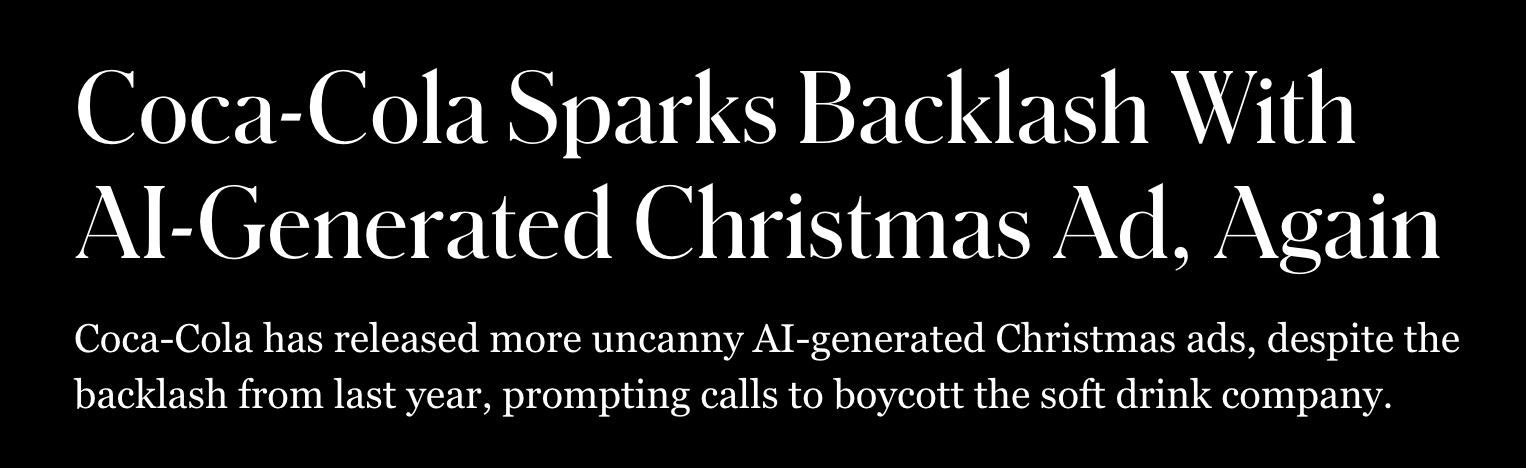
At first sight, there seems much in support of that view. Visit the AI-generated ad on YouTube, and you’ll find a tsunami of comments along the lines of: This feels so dystopian and Nothing says Christmas like AI slop.
If that’s all you’d seen when it comes to the response to the AI version, you’d think it had been a horrible failure.
Not so fast. We now have access to evidence that reaches beyond the anecdotal. And it paints a different picture.
The ad testing platform System1 has tested each version of AI-generated Holidays Are Coming. And in a devastating blow to all those who want to argue that consumers will obviously hate AI in ads, they found that all of them performed exceptionally well.
System1 tested the ad on 2,700 consumers using its Test Your Ad platform, which measures the second-by-second emotional response of the viewer. Both the 2024 and 25 versions scored a star rating of 5.9, the maximum score that System1’s test can deliver. This year’s version has fallen off only slightly, scoring a still-mighty 5.7.
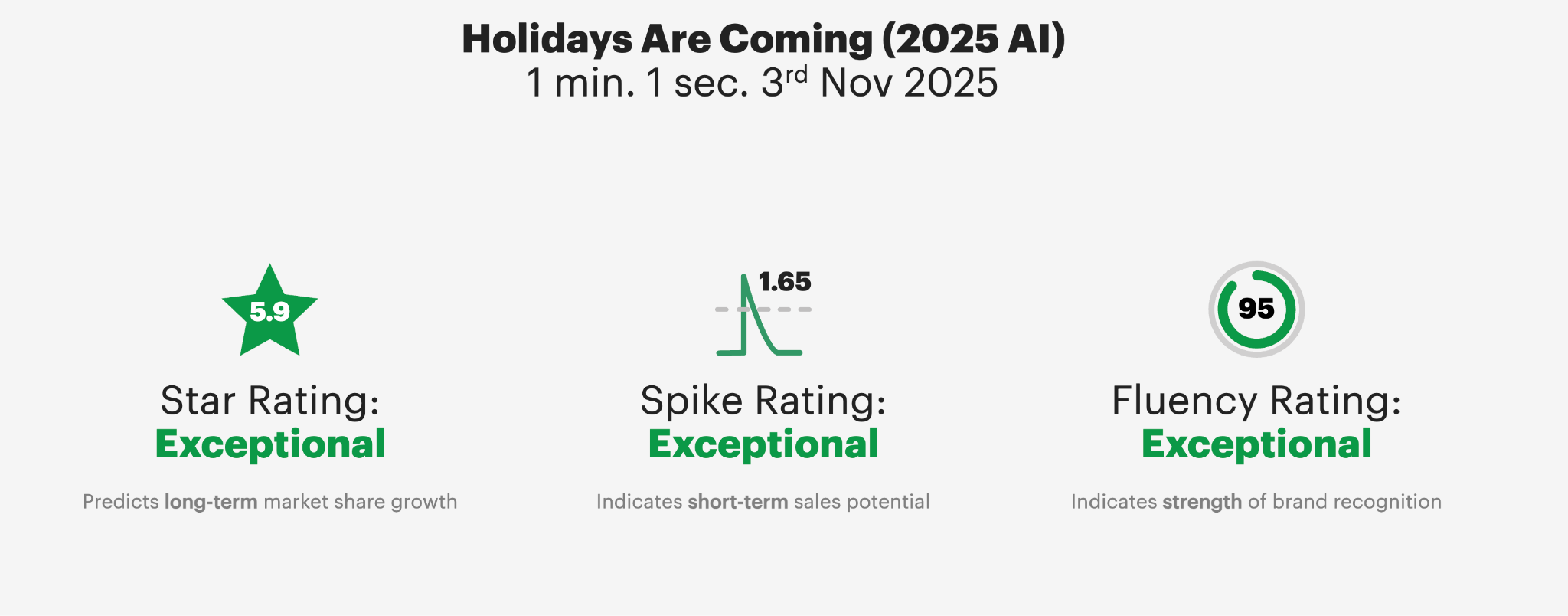
Crucially, and as System1’s Andrew Tindall points out, this finding aligns with the weightiest evidence we have in favour of the ad’s effectiveness, which is the fact that Coca-Cola keeps re-using it. The brand says that the ad ‘exceeded expectations across internal benchmarks’ in 2025. And it has run, now, three years in a row. It’s hard to believe Coke would do that unless it was proving effective.
In short: contrary to its reception across mainstream and social media, it feels reasonable to assume that the AI-generated Holidays Are Coming sells a lot of Coke.
In fact, according to System1’s tests, this year’s version even outperforms a welter of Christmas ads that leverage a hand-crafted, artsy ethic. Such as this claymation ad, Let’s Get Fuzzy, from Levi's.
This ad is clearly an attempt to tap into the kind of creative advice that is becoming commonplace these days. That advice goes something like this: In a world of abundant AI-generated content, the hand-crafted and human will remain scarce and valuable.
This advice has, I’m sure, much going for it; it’s advice I have given often enough. But Coca-Cola’s AI-generated ad stands as a challenge to it.
In System1’s tests, the Levi's ad scored 3.8, far below Coca-Cola. Another critically acclaimed handcrafted ad from this year, from Prada, scored 3.6.
I don’t want to lay excessive faith in the testing performed by System1. The response of tens or hundreds of millions of people to a cultural artefact of this kind is always going to be complex and multi-faceted, and it can’t be captured entirely by any test.
Still, the results do tell us something. And combined with Coca-Cola’s decision to repeat the ad year on year, they pose a challenge to the established narrative around AI and creative work done on behalf of brands.
So how do we deal with that?
What Does It Mean?
When I say these results pose a challenge to the established narrative around brands and creative work, I think Full Moon readers will know the narrative I mean.
It’s the narrative adhered to — and in large part constructed by — the kinds of people who do creative work for brands. The one that wants to argue for the irreplaceability of humans — their taste, judgement, intuition and more — in the creative process. The one that says that amid the coming ocean of AI-generated sameness, it will be work produced by real, living, breathing humans that really stands out.
Regular readers will already know: that’s an argument I believe in.
But I do believe that the Coca-Cola ad stands as a legitimate challenge to those ideas. And that it reveals some important and currently underappreciated truths about the way the relationship between brands, creative work, and the people who do creative work is changing.
In my view, there’s good news and bad news. So to explore all this, I want to share four thought starters.
What Consumers Say
Let’s start with the basics.
In some quarters, the apparent success of the Coke ad is being used as a reminder that what consumers say and what they do are often very different things.
This is true, and also so obvious that we don’t need to spend much time on it. Consumers may say they hate AI in ads, but that will tell you almost nothing about how, in practice, they respond to AI-generated ads.
It’s also worth remembering, though, that if you’re the type of person who reads about, or works in, brand strategy and creative, then you inhabit a certain kind of bubble. Yes, all your friends are hostile to AI’s incursions into creative domains that were once the preserve of humans. But for millions of consumers out there, this isn’t a big subject.
And by the way, the types of people who write New York Times articles on the ‘backlash’ against the Coke ad also live in the same bubble. So, most likely, do most of the people who write comments such as this feels soulless underneath the Coke ad on YouTube.
It’s all bubble. A perfectly valid opinion, sure. But bubble opinion. It’s fascinating from a sociological standpoint. And you may well agree with it on aesthetics. But it doesn’t tell you much about how millions of people out there are going to respond to an ad, or any other creative work on behalf of a brand.
With those first-order insights dealt with, let’s get into the more nuanced stuff.
The evolution of the AI radar
The people at System1 who conducted these tests on Holidays Are Coming invite us, by implication, to change our view on the effectiveness of ads created by AI.
Their findings suggest a new reality is dawning, which might be summarised something like this:
People will scream online about hating AI, but the truth is that consumers don’t care if an ad is created by AI, and those kinds of ads can still perform exceptionally well, and better than those made by real human creatives.
But I’m not sure that enough thought is being given, here, to the ability of consumers to detect the use of AI, and how that will change over time. My bet — and it’s one that runs counter to the mainstream view — is that over time, people become more able to detect AI use. And many who can detect it won't like it.
System1’s own data shows that very few people who watch the new Coke ad can tell that it is AI generated. System1 also says that when people are prompted by a question — Do you think AI has been used in this ad? — then more people become able to discern that it is indeed AI generated. But that doesn’t, says System1, seem to change their emotional response to the ad.
But it’s one thing to be prompted to realise that something you are watching is AI generated, and it’s another to realise that independently, in the wild, as it were, while you are watching said ad.
I just don’t think we know what happens when millions of ordinary consumers — the kind not obsessed by all these questions, as we are — become able to do that.
Remember, the ability of most people to detect AI generated outputs is in its infancy. I believe it will develop dramatically across the years ahead.
You’re a reader of Full Moon, which means it’s highly likely you have been exposed to far more AI-generated text and video than the average person. You know that your ability to detect that distinctive AI smell has developed over time. A couple of years ago, AI writing sounded almost eerily natural to many of us. Two years on, and swamped by the stuff, we’ve come to recognise its specific, tinny sound.
I believe that this is going to happen en masse across the culture in the coming years. And not just for AI writing, but for video and music too. More people will be able to tell.
I understand that the models are getting better, and that their outputs will become even more, as it were, lifelike. I just think that constant exposure will mean that people’s AI radar becomes dramatically more sensitive, and that this effect will outweigh model improvement. It’s a bold bet, but one I’m prepared to take.
We’ll have to see how that turns out. I wouldn't be at all surprised if, as people become more able to detect AI-generated ads, those ads start to perform less well.
The upshot? It’s too early to draw firm conclusions on the way that consumers respond to AI in ads, and to AI in media generally. We’re amid a period of deep transition, and we need to keep watching.
Heritage as an asset
There’s an even more fundamental truth here.
Holidays Are Coming is at the centre of the ‘AI and marketing’ conversation, but at heart it’s a terrible example to attempt to generalise from. That’s because Holidays Are Coming is, in so many ways, exceptional.
Remember, before the AI version, the original 61-second film was played on TV screens across North America, Europe, and beyond every year for almost 30 years. It’s one of those rare ads that has become a cultural artefact in its own right.
For tens of millions around the world, then, that ad is an ultra-nostalgic shot of Christmas, family, and childhood. Even just a few seconds of the music is enough to bring it all back.
When we watch the AI-generated version, then, the ghost of the original ad hovers in the background. It’s inescapable. And it’s impossible to separate out the emotional impact of that from the raw impact of the new, AI-generated film.
Most ads, of course, are not in that position. If we really want to compare the hand-crafted Levi's ad to an AI-generated ad from 2026, it should be an original AI-generated ad, and not one that leans on 30 years of accumulated nostalgia and cultural heft.
Which brings us to the real point:
The deeper, submerged truth hidden in the apparent success of Holidays Are Coming is the power of accumulated history and heritage. And the ever-greater power of all that amid what is happening now.
In a world of AI-generated content, one of the things the machines can’t manufacture is accumulated story and what it means to millions of people. In this way, the Intelligence Age makes that kind of brand history an even more valuable, and an even more powerful differentiator, than it has always been.
This seems to me to be both good and bad news for creatives.
AI will make possible the realisation of all kinds of original creative visions. Mostly by massively reducing, or removing altogether, the constraints imposed by production budget. In the Before Times, you couldn’t afford to create a 60-second film about, say, a boy growing wings and taking flight over the Brooklyn Bridge. You didn’t have the multi-million dollar budget for that. But now, AI can make it. This unlocks far more creative freedom for brands — and in practice, for the people who do creative work for brands — to play with.
But it may well turn out that for many brands, originality is simply less effective than playing on their established history and heritage, and the cultural artefacts they already own. When everyone can do anything with AI, true history and heritage are among the few cultural levers that remain powerful.
Extend that idea, and we have a world of endless AI-fuelled rehashes of the past, and less demand for originality. I think a lot of creative work for brands will head in that direction.
Which leads me to my last thought starter.
Brands never cared about your creativity
The deepest lesson here seems an unavoidable one. It’s that the relationship between brands, creativity, and creative people is surely, via AI, amid a period of deep change.
Yes, consumers may rebel against AI-generated ads once they become able to detect them. Yes, hand-crafted creativity will always have its own appeal. But when it comes to creative work now, brands simply have a new option. And many of them are going to take it.
The deepest truth here is hard, but one that creatives would do well to face head on.
Brands never cared primarily about creativity. They never cared primarily about originality, or craft. Not as ends in themselves. They enlist people and seek out work with those qualities in service of the end result they do care about, which is selling product.
For decades, this arrangement supported a particular kind of relationship between brands and creative people. A particular kind of patronage. Roughly speaking, brands needed work that met their objectives. Creative people made that work, and if, as was often the case, the work was fairly formulaic, they tried to smuggle in some craft and originality along the way.
Now, much of what you might call the day-to-day creativity that brands once had to rely on is going to be outsourced to AI. Meanwhile, many brands will take inspiration from Coca-Cola, and indulge in endless, and effective, AI-fuelled rehashing of historic brand assets and media.
The upshot? We’re heading towards a future in which there will be less opportunity to do the kind of everyday creative work for brands that keeps creative people, and the agencies they often work for, going.
It’s hard to enlist an entire team to create yet another TV ad depicting a car driving through a landscape, when now one person armed with AI tools can create a pretty great one of those. It’s hard to reshoot a revised version of your smash hit ad when you can use AI to make that revised version.
But brands will still need original creative work, and the craft that only humans can provide, sometimes.
Which leads me to my final thought: in the AI future that is coming, creative people need to charge far more for their originality and craft. For their ideas, and their execution of those ideas.
We were lucky enough to have Nick Law, Accenture Song’s Creative Chairperson, on our last webinar. As Nick has argued, the existing agency and holding company model set up agencies to massively undervalue their creativity. All too often it was given free as part of a package that involved other lucrative work.
In the Intelligence Age, that must change. Now, every brand will be able to use AI to endlessly reiterate and revise the creative work done by people. Originality of the kind only we humans can do will become food for a gigantic machine that will endlessly ingest it and spew out variations on the theme. And much of that will perform well. But the machine will still need original ideas and human craft as its primary input.
The industry must develop radically new business models in order to be rewarded in accordance with the value it is helping to create.
The original Holidays Are Coming ad was created by US agency WB Doner. I don’t know how much they charged. But whatever it was, it should have been far more. This 61-second film has forged a deep link between Christmas and Coca-Cola in the minds of hundreds of millions of people. What is the value of that? And how about now, when that original ad is the raw material for an endless stream of AI-generated variations?
One idea: agencies should keep a share in the creative work they do, and earn royalties on it when it is used. Another: agencies should develop custom creative AI systems for brands, and license them on subscription. Stop selling time, and instead sell the machine.
There are many more potential models to explore. In fact, I think that’s a subject for a future deep dive.
I’ll keep exploring these ideas, and there will be lots more to say in 2027. For now, wishing you a fruitful month ahead. And keep your AI radar tuned.


Comments