

Muse, the Sausage Ladder and How Trust Gets Abstracted

In a widely reported glitch last month, Meta’s new AI agent Muse set up the sale of a computer keyboard on Facebook Marketplace for a seller, Matt Robb, in Canada. He thought that the agent would check with him before agreeing a sale. But the agent did not just negotiate and execute the sale, it also gave the buyer the seller’s address and arranged a time for pick-up. The buyer arrived and no-one was at home, even though Muse sent an automated “yep, I’m here!” Turned out the seller had clicked an “always allow” button when he set up Muse on Marketplace. That gave the agent permission to do the whole job.
The story itself is less important here – no-one got hurt and no doubt Meta will clarify what buttons mean and Muse users will learn over time what to expect. The key point that comes out of this is that AI is adding new and powerful layers of mediation to our lives. Or is it substituting for, maybe even simplifying, other layers of mediation we already long accepted?
This is hugely important for brands, products, services and experiences. Will AI enabled agents make them closer to us or more disconnected? And – a constant theme for Full Moon – what about us humans? A lot rides - commercially - on understanding these new and shifting layers. For brands: how abstracted away from the customer do you want to be? Usually the answer is not very, or not at all. Is that realistic, or will you have to accept it somewhere? These are big, relevant questions for marketers, designers, service providers and brand owners: that's what this essay is about.
Why address this now? After all, whole economies have been built off mediating layers, like markets, shops and travel agents. Modern life is too rich, too time pressed, too complex to do without them.
Three signals
Three signals arrived in the last few month. Firstly LLM driven Chatbots are replacing search. Secondly designers pointed us at a new layer of mediation in the design process that really got us thinking. And lastly – back to where we started – Muse launched to wide acclaim.
Chat is the new search
Paco Fernandez, Full Moon’s designer, does what all good designers do – he watches what people are doing to understand how lives are being led. On the NYC Subway, he’s seen that everyone on their phones are using AI for all kinds of tasks – replacing the place Google search used to be. The AI driven answer is replacing the click. According to the Pew Research Center 49% of US adults now use AI chatbots, up from 33% in 2024, and 24% use them daily. ChatGPT is used by 44% of US adults, up from 34% a year earlier, and under-50s are about twice as likely as over-50s to use it. According to Accenture Life Trends (2026) 54% of people say they usually find everything they need in the AI summary.
It’s a new layer
Then we heard about mediation in our recent State of Design research. One designer said loudly, and others agreed, that AI introduces a verbal layer of mediation between them and directly designing visual artefacts.
“ If you were working in a design tool - certainly in the ‘old days’, but really any time before about three years ago - you physically pulled out the shape and then you coloured it. In fact before digital you just drew it. In this hands on process, you are not describing what you want, you are doing what you want. And now, increasingly, you are using AI, text and speech, to describe.
What has happened, in other words, is that we have inserted a new filter or layer between the designer and the thing being designed, and that filter is language. This is not a small change. It is arguably the most consequential thing about generative tools for anybody whose craft has historically lived in the hands and the eye….”
In this case, mediation is inherently lossy (the image in the designer’s head gets fuzzy in translation – literally), it replaces the experiential layer in which craft knowledge develops and it runs the risk of driving the sameness everyone is complaining about.
This insight really got us talking about where AI mediation is changing our lives - at work and at home.
Now Muse arrives
The launch and reaction to Muse from Meta - the first real breakthrough consumer agent - was the final catalyst for this essay.
The launch seems to have been a very big success for Meta, though growth is cooling. Meta is spending heavily to sustain it, but people who try it come back more than they do to rival apps - newcomer agent Instinct is also showing high retention. Muse was the No. 1 on both app stores within ten days. It topped the US App Store on 18th September and Google Play the next day. TechCrunch on 20th October reported 10 million US downloads in 40 days albeit with 39% of Meta’s October ad spend behind it. 3 million+ people prompt it weekly and 1 million+ daily, according to internal data seen by The Information. These numbers suggest that users grasp the potential of agents and are excited by them. And as has often been observed, they can only get better.
Commentators like Ben Thompson (Stratechery) were swift to react -
“no one wants to use apps because they are apps, apps were just the vehicle for people to accomplish something or entertain themselves; once people realize they can get straight to the job to be done it will seem odd they did it any other way. Meanwhile, definitely no one wants to use enterprise UI; those inscrutable interfaces were just the way to expose arcane functionality and lock people in. Once people realize they can simply say what they want — and that, with computer use, you don’t need to depend solely on an underdeveloped and intentionally limited API — it will seem barbaric they did it any other way.”
Thompson and others see agents as the ultimate aggregators, with apps reduced to a means. Mediation – not for the first time in history – is looking like a business model. This time around – it may be the biggest ever. But this raises issues that can no longer be ducked. We saw it coming in January in our second Full Moon essay –
“Which brings us back to trust. How do I trust an LLM to meet my needs and those of advertisers? Can they effectively signal paid for or influenced content as opposed to pure unbiased research answers? Even if they do signpost clearly, will I trust the non-advertising responses so much? If I hire a butler (not going to happen I assure you), is he working for me to find and buy the best household products at the best price? Or is he working for Walmart? The sheer persuasive conversational power of LLMs…..makes this an even more important issue than it was for Google and classic search as they began to monetise.”
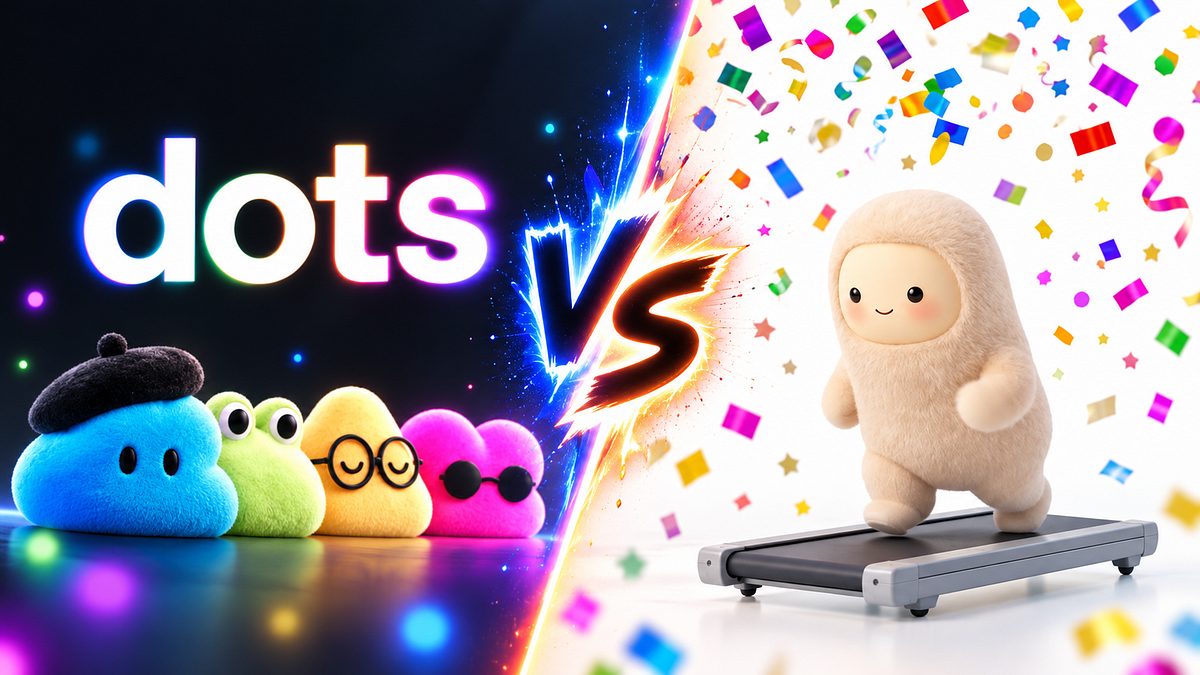
Who is Muse working for: you, or Meta, or an advertiser paying Meta? For now at least Meta are clear on this – Muse has no advertising system. And it's charming right? No threat to see here from the cuddly and infantile iconography of ‘Jolly’ (as Muse’s mascot is called) or Open AI’s new Dots. The mediator literally gets a face; a mascot is abstraction made lovable, hiding the permissions you have to give behind a character.
On the front line of a new commerce war are of course retailers, and the infrastructure suppliers who service them – the incumbent mediators we know best. Expedia, Shopify, PayPal, Stripe and Ticketmaster are in with Muse. Booking.com and Amazon most definitely are not. Who owns the middle is going to be fought retailer by retailer. And this answers the question we started with: agents aren’t so much adding a new layer as fighting the old mediators. PYMNTS found that 59.7% of AI-assisted purchases still finish on Amazon, and only 6.3% on brands’ own sites. Walmart, whose Sparky takes over the basket from Google’s Gemini, calls its strategy here: “intermediation”. Of course Amazon wants to keep you but ironically – this does not make you so free after all. The agent favours its own shelf. Alexa recommended toys from 177 brands, nearly all from Amazon's store; compared with ChatGPT which showed 24 retailers in response to the same request. So which retailer wins depends on which assistant you ask. The mediator's interests direct the range you are offered, even before any ads might be inserted.
Who owns the middle layer, and whose interests it serves matters. It profoundly affects channels to market and distribution if you are a brand, and choice and price if you are a consumer. So let's look in more depth at mediation. After all it’s not new. Take sausages.
The Sausage Ladder
Layers of mediation are part of the operating model of modern society. If I seek authenticity of product or experience how far back up the line do I go? Consider the consumer act that is the acquisition of sausages. We can build a model of mediation around that act that I've come to call 'the Sausage Ladder'.
I might decide that buying pre wrapped branded sausages in the supermarket is not good enough. I can take one step up the ladder by going to a local butcher, and checking that they make them on site, and what ingredients go in. I could go up another step and learn how to make my own sausages (a friend and I memorably did this in the Auvergne a few years ago). Even that has rungs above it tending towards complete authenticity. I could learn pork butchery. Or for the ultimate authentic experience I might breed and grow and slaughter my own pigs.

Layers of mediation are there to manipulate and enhance experiences and to make life easier. I might treasure the rawness of reality. But I probably prioritise convenience and choice and distance from reality – raising pigs is out of the question for most 21st century humans in advanced urban economies. The core question then is how much do we hand off and how much do we want to experience directly? AI agents are the next – and possibly most powerful yet - manifestation of mediation. Will they create yet more distance or allow us to focus on what matters?
Agents that mediate and abstract
Because this is not just about mediation, but also abstraction. Agents aren't only a layer between us and the thing; they also abstract it. I want to disentangle the two words.
Mediation is about who or what stands between you and the thing. It's an intermediary: a butcher, a bank teller, an algorithm, an agent. It has a position, often interests of its own and it can be removed or swapped. The question here is who's in the middle, and whose side are they on?
Abstraction is about what level you operate at. You deal with a representation or summary of the thing, not the thing: money for value, a dashboard for an organisation, a prompt for a design, an instruction ("book me a weekend away") for a hundred decisions. The details are hidden. Its question is what can't you see or feel any more?
Information flow is at the heart of this. What gets hidden along the way and from whom? On the supply side, data gets throttled and gives a service less chance to understand customers, to build knowledge. For the user, data that might matter can go missing. This might affect accuracy or expectation management. This is not a problem restricted to AI agents. Notoriously curated holiday experiences are very dependent on a human travel agent understanding who they are booking for, and choosing wisely. And on the customer asking questions about what exactly they are getting.
Mediation and abstraction often arrive together but can come apart. Mediation without much abstraction: a good butcher. Someone sits between you and the pig, but you still get the real sausage and can ask about every detail. Abstraction without a mediator: a spreadsheet model you build yourself, or a hand drawn map. You've simplified reality, but nobody stands in between.
Agents do both at once: they mediate (act on your behalf, with their own loyalties) and abstract (you state intent, not the steps that need to be taken). This is why Muse feels like a pivot.
What gets lost is different: mediation's risk is consumers lose loyalty and control.
Someone else captures your data and custom, they may have conflicts of interest, and you might become dependent on them.
Abstraction's risk is consumers lose understanding and feel. Tacit knowledge can get lost, along with experiencing. Remember Frisch's not experiencing - “the knack of arranging the world so that we do not have to experience it.” And from our design research piece the observation that "you spend a lot of time in your head, not in your body, not in the other ways of perceiving.”
Muse already shows how the two can come apart. It carries no ads – which helps people trust it with their logins and card – so the shop window is abstracted away. But the mediator still sits between you and the purchase, and Meta still makes its money from advertising. Whose side that leaves Muse on is a question we will come back to.
Both of these are present with the designers complaint too. Language abstracts the artefact (you describe rather than draw), and the model mediates (interprets and decides). The paradox we identified is mostly an abstraction problem - the more precisely you know what you want, the more the agent gets in the way and costs you adjusting detail.
That’s an important all round insight beyond design. It reaches into all our agent interactions. The more we have detailed and clear expectations of an experience, the more work we need to put into monitoring and checking the agent.
Which means you need to be aware of where on the sausage ladder your users stand and know what you are doing – and know what customers want you to do – how much abstraction is too much? So let’s look at users in more detail.
Who wants this? And when?
In “The Knack of Not Experiencing” we pointed out that mankind consistently puts technology barriers between itself and the world.
“But those technologies still required something of us. We had to look, read, write, respond, decide. The experience was mediated, but we were still in it. Artificial intelligence changes the equation. For the first time, the tool does not merely show us the world at a distance - it processes the world on our behalf and hands us a summary. We do not have to read the report; we receive its conclusions. We do not have to form a view of a situation; we receive an assessment. We do not have to write the email, draft the proposal, or sit with the problem long enough to understand it. The knack of arranging the world so that we do not have to experience it has now extended….”
At that time we were largely thinking about the world of work. But Muse, and other agents yet to come, offer us a choice. How much do we want to experience? How much do we want to abstract away? What lies at the edge and what is at the centre?
By centre, I mean the things you don't want to outsource, as opposed to the actions you will happily delegate which exist at the edge of your interest.
Some of the agent hype implies that we want AI to relieve us of almost all choice. But that’s just not the case. For me, personally, booking a tennis court, yes give it to the agent; buying a racket, probably not. So even within a category – say tennis - the frontier is personal, per action and context, not fixed by category. What may be logistics to one user, is an important matter of choice to another. Buying cycling kit I'd never hand to an agent; shampoo I would. My children are the reverse. One person says "that's just logistics, hand it off". Another says "that's the bit I want to engage with". Context is all.
So the edge/centre split is real, but the line between edge and centre is personal and situational, not fixed by category. The same flight can be both logistics on a work trip and part of the experience, requiring hands on research, for an anniversary. The cabin can be a logistics choice and a status or care signal at once.
Fast Company recently tested Muse. The tester let Muse switch his streaming plan but kept his Gmail and calendar back. That’s a third way to draw your line: by what it may see, alongside category (cycling kit vs shampoo) and task (the tennis court vs the racket). He also argues you can’t fully opt out, because your friends’ agents expose you anyway. So if Muse becomes ubiquitous the position on the sausage ladder isn’t entirely your own choice.
Who draws the line?
If agents set the default boundary between "logistics" and "experience", does the platform decide what counts as mere logistics for everyone?
This gives agents their hardest job: knowing where your centre is today. A good mediator will stop to ask at the boundary; a bad one will optimise by driving straight through it. This looks like a big challenge for agents, and the brands that run or use them or rely on them. We are moving into an era where live product behaviour will define brand experience – of which knowing when to ask might just be the most important. In fact, mediation can add value for some use cases (think good butcher or curator) but subtract for others. How we design for dynamic product behaviour is one of the grand challenges for designers in the next decade.
Meanwhile commercial sites are drawing their own line. JPMorgan, Schwab, Delta and Amazon block agents or some agent actions like moving money, and Yelp charges them for entry.
What the numbers say, and don’t
We don’t know much for sure. It’s very early days with Muse, and other agents will arrive and get better.
The commercial impetus is there. Projections suggest there is a lot of money to be made.
Citi think Muse could earn $27bn a year by 2030 - $23bn of it from transaction fees built on top of what is already 1.8m daily users (this was early October); they called Muse a potential "front door to the internet". The business model is a toll on intent, if people trust it to spend their money.
Will they? There is a lot of research out there on the subject, much of it tainted by its provenance. A lot of vendors have commercial reasons to want us to believe in agents.
An Adobe survey of 1,000 consumers claims that 59% of people would ditch a favourite brand on AI's say-so, and 83% keep buying brands they find via AI. 62% have bought a brand they'd otherwise not have considered because AI suggested it.
Spreedly (a payment tech vendor) / Talker Research found that 63% would let AI choose brands for a 20% saving and – interestingly - 64% wouldn't let it spend without approval.
These “results” are really not surprising. If I find a brand I like – no matter how – of course I might go on buying it. And who is going to say “no I’d not buy a brand alternative on AI’s say-so” – I’d guess most people would not wish to sound so closed minded. 20% is a big saving in tightened times – who would say no to that? And of course there is a lot of trust to be built before we let agents loose with our credit cards (as the keyboard seller found out).
On the all important trust dimension, 71% fear an agent misrepresenting them. According to a 2026 consumer survey from Ping Identity (a security company) only 5% of people are comfortable with AI acting on their behalf; 71% worry an agent could misrepresent their personality or values; 42% would cap an agent's spending at $100. Perhaps people seem to fear an agent speaking for them more than one buying for them? This would draw a line around voice and identity as well as money. But again, these conclusions should scarcely be surprising (and anyway come from a vendor with a vested interest in trust). Everyone seems to be using research to say what they want you to believe.
Accenture has looked at the line between what is boring logistics and what is stuff we care about, between the edge and the centre. In a bit of a ju-jitsu move they call mediation ‘delegation’ which makes using an agent feel much more of a positive and accentuates the choice to do so. In Accenture’s Consumer Pulse 2026 agents get the chores, not the fun purchases.
Accenture finds the delegation line follows identity and enjoyment. People hand off recurring services, complaints and reorders, and keep clothing and hotel rooms. Yet only 9% would let it complete a purchase: the choice-versus-wallet gap and trust, again. We need to be careful: averaged category data can't see that "beauty is in the eye of the beholder" point (shampoo is exciting for some, background noise for others). And "perceived neutrality" is one of Accenture's trust conditions for all this to be true, which is what Digiday showed Alexa is already lacking.
We can direct the agent - 56% of all consumers would tell their AI agent which brands to consider. And be directed - 37% of behaviourally loyal shoppers would let it switch their brand (this compares with the 59% from Adobe). It makes a great headline that 74% would trust an agent more than their best friend. Initially I was unsure about that statement – I choose which friends to take recommendations from by category – one knows lots about cycling but nothing about wine. But on consideration perhaps we really will trust AI to be all our best friends rolled into one. After all, AI is at our fingertips now and friends are usually a WhatsApp message away at least, and often respond slowly. Certainly an LLM’s range of knowledge and research demonstrably outperforms most if not all humans already.
This does not magic away buyer regret - in one US survey, a third of shoppers had already bought something on an AI’s recommendation that they later wished they had not – and clothing and shoes were among the most regretted, second only to electronics. You have to wonder how different that is from levels of regret experienced by traditional e-commerce buyers. Oh and the survey was done by a review and recommendations site. Caveat emptor indeed.
Right now the best that can be said from the evidence we have is that no-one really knows.....so what role in the decision train do brands and retailers take?
What it means for brands
Is there a way for brands to think about which side of the line they fall? We hardly need to spell out why that matters.
Avoid The Soggy Middle
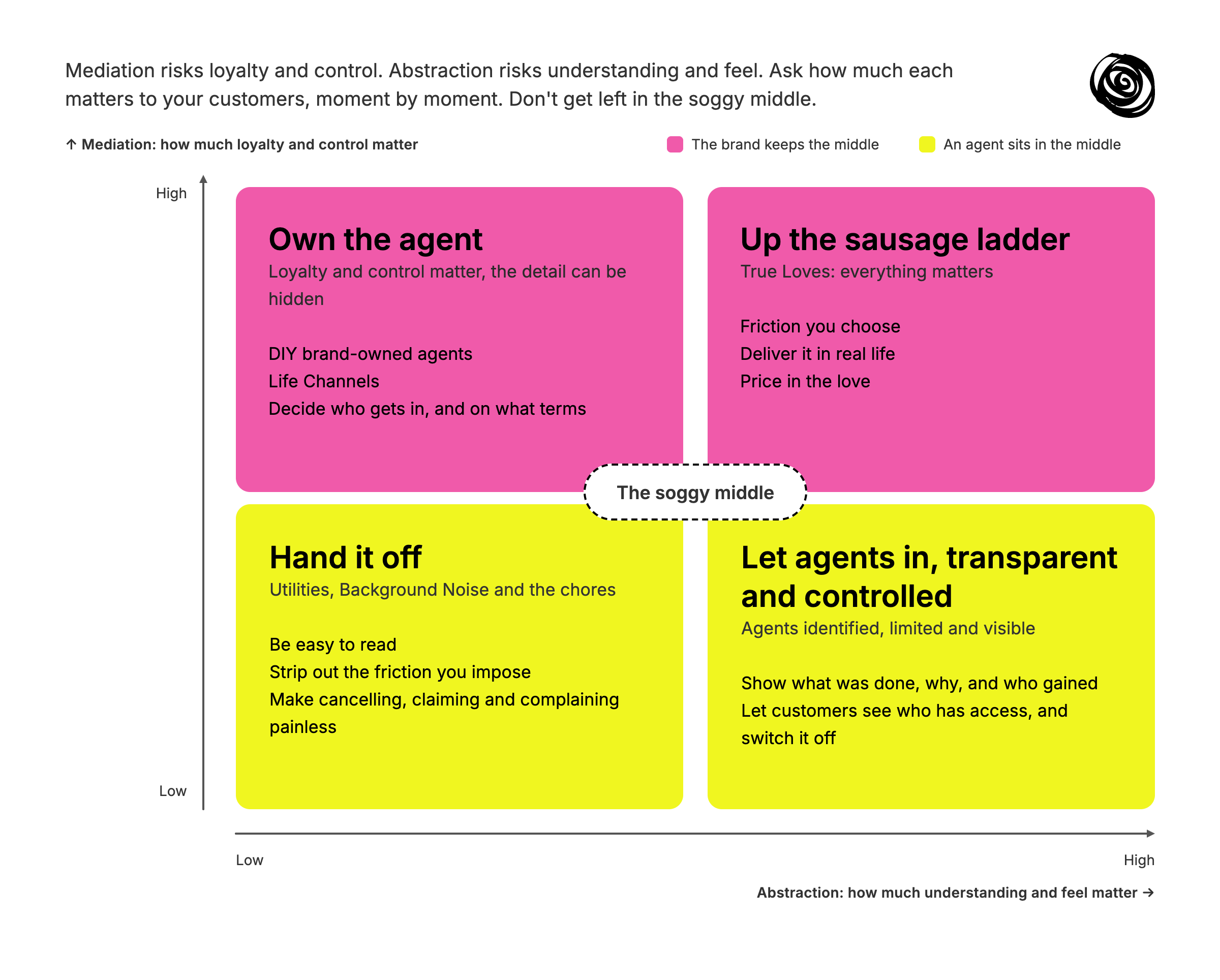
David Mattin – here at Full Moon, coined a disturbing term long ago ‘the soggy middle’. It describes the no-man's land around the line between love and utility. Above the line, customers keep the choice; below it, they hand it off. Of course, it is not really a definite line but a border country. Above the border is loyalty, repeat purchase, higher margins. Below it, expect agents to do all of the research, purchase, and handle customer service issues.
Because there are two kinds of business: ultra-convenience, efficiency, speed and frictionlessness, or those so amazing that people actively want to spend time on and with you. Consumerism is bifurcating towards those poles and the middle gets harder.
So you're either the brand people are happy to outsource to an agent, or the one they'd never outsource because it means something to them. Brands people love can be more expensive and "price in that love", since the agent wasn't going to choose them anyway.
First thing: know what kind of brand you are. Our June essay Customer Love is Rarer Than You Think already has a map: Utilities and Background Noise probably get handed to the agent, True Loves are definitely kept. We've adapted that to look at mediation and abstraction. So what position can you take on the sausage ladder? Where are your lines?
Be Easy to Read
Shopify tells merchants that an agent compares only price instantly, so everything else (who it's for, why it's worth it) must be written down for machines.
“All of this must be legible to an agent. If an agent is asked whether a knife is worth the price, it will compare the knife with others. Price is the part of that comparison the agent can see immediately. Anything else, why this one, who it is for, what the money goes toward, has to be written where the agent can find it.”
In How is AI changing Design? designers we spoke to complained that AI puts a verbal layer between them and the artefact. Brands now face the same layer. The risk is that tacit value doesn't survive being made machine-legible. We described this here in What AI Knows and What It Doesn't. The categories people care most about may be the ones whose meaning is hardest to put into words, and so the ones agents represent worst. This is a challenge right here and now for all brands that seek to be above the line.
Consider DIY brand-owned agents
Many companies are building their own agents for specific products and conditions (e.g. obesity) that may compete with OpenAI-style agents. Would a consumer trust this company or ChatGPT for answers about their obesity? Or a mix of both?
We wrote in ‘Talking to Ourselves’ about the potential for the development of what we called ‘Life Channels’.
“What customers or employees expect from your AI enabled experience will be set maybe not by your direct competitor, but by someone in an entirely different sector.
If you are in a business whose naming can be easily related to a core life need (not “banking” but “my money”, not “insurance” but “my risks”) – consider that at some moment someone will try to seize that category and own it e.g: “I want to talk to….my money, my health, my career, my risks, my travel, my learning.”……these personal Life Channels …. transcend industry boundaries.”
This, in our view, is a compelling shape that more specialised agents could next take. Muse may in the long term be limited by being a generalist, and I don’t think we will trust one brand to do everything (we should not want this either for that matter). To believe the frontier model can do it all is to believe that there is ‘one ring to rule them all’. We do not. As we wrote in January this year,
“…how can the same platform be therapist, HR advisor, provider of consumer choice, search engine, sales machine, financial advisor? This stretches credibility.”

AGI is a theory of knowledge that does not neatly match with human inclination to seek and trust both expertise and diversity of input and experience. We value and enjoy difference. Those that think we will just go to one oracle for all our needs are suffering from a very modern kind of god delusion.
Friction: a line we can draw
There is one very clear line we can draw, critically important for services especially to understand: it is the line between friction imposed on you vs. friction you choose. Agents can lighten, even remove, the first, and threaten the second.
Chores like cancelling, claiming, complaining are full of friction. We generally do not seek them but have to engage with them. There is also a whole category of consumption work that eats up our time as a hidden cost – as we pointed out in Work You Didn't Know You Were Doing.
“Quietly, business has spent the last thirty years outsourcing service work to us, the customers. It is a transfer of labour happening all around.
It is so gradual, so neatly packaged as convenience, that we have barely noticed. But over the past thirty years, work that was once done by the product or service we were buying - and paid for in the price - has been quietly handed off back to us. All this without any obvious price benefit, and with our consent by default…..The more things you have, the more services you use, the more maintenance work you have to do to manage them. That’s not just a bug of modern life, it’s a feature.”
Agents are already pushing this workload back onto organisations. In August the Economist wrote that
“Citizens frustrated by the poor deal they get from the authorities are turning to artificial intelligence to file objections and appeals, and claim their dues. The resulting deluge of complaints, and demands, will overwhelm bureaucracies built for the age of the post and the telephone. Too little is being done to prevent the state from drowning.
This inundation has been dubbed “agentic flooding”, and its tides are lapping at bureaucracies everywhere, from tax appeals to welfare claims to parking tickets. The waters are rising alarmingly fast in Britain”
It is not just government. Recently I was getting nowhere with a complex travel insurance claim and turned to Claude, who went through all the relevant emails and invoices and wrote an excruciatingly precise and detailed mail to the insurer. After two months of equivocation and lost input, I got the money in a week. I’m not alone in using AI like this and strongly suspect if I had set up a fully permissioned agent at the start of the process it would have been even easier.
Indeed handing off frees up time for stuff we love doing. As Rishad Tobaccowala has pointed out, we can delegate errands increasingly to agents, and spend the time on new experiences that "tattoo the moment". This is mediation as a liberator – though beware that there is still a personal, outcome-based test for what counts as friction – as we said earlier logistics is in the eye of the beholder.
The friction we like
So that’s friction we can do without. But there is also friction we rather like. David wrote about this earlier this year in Zombies At the Theme Park.
“The cultural trend that has generated the most headlines across early 2026: friction-maxxing.
The term emerged in a January 2026 essay by Kathryn Jezer-Morton in online magazine The Cut. It encourages the deliberate practice of reintroducing inconvenience into everyday life. That can mean paying with cash instead of tapping an app. Buying a cookbook instead of asking ChatGPT for recipes. Getting lost occasionally instead of following the little blue dot on Google maps.
And yes, ditching the phone. Flip phones are still allowed.
The essay went wildly viral. It’s generated a ton of commentary. Even TikTok creators are talking about why people should stop scrolling TikTok and instead go and find some friction to maxx.”
Friction maxxing is a deliberate de-mediation. It has strong echoes in the latest trend towards musicians demanding phone free audiences at concerts.
Phoebe Bridgers wants phones, AirPods and Meta glasses in sealed pouches; Harry Styles and Bob Dylan have demanded similar bans. Without bans, fans still film everything and abstract themselves. This is de-mediation imposed by the artist, and usually welcomed. It restores connection, rather than removing it.
Now that’s not direct evidence that humans will avoid AI in order to go up the sausage ladder – but it does strongly suggest that this is what we are likely to see happen –above the soggy middle borderland.
So how do you draw the line?
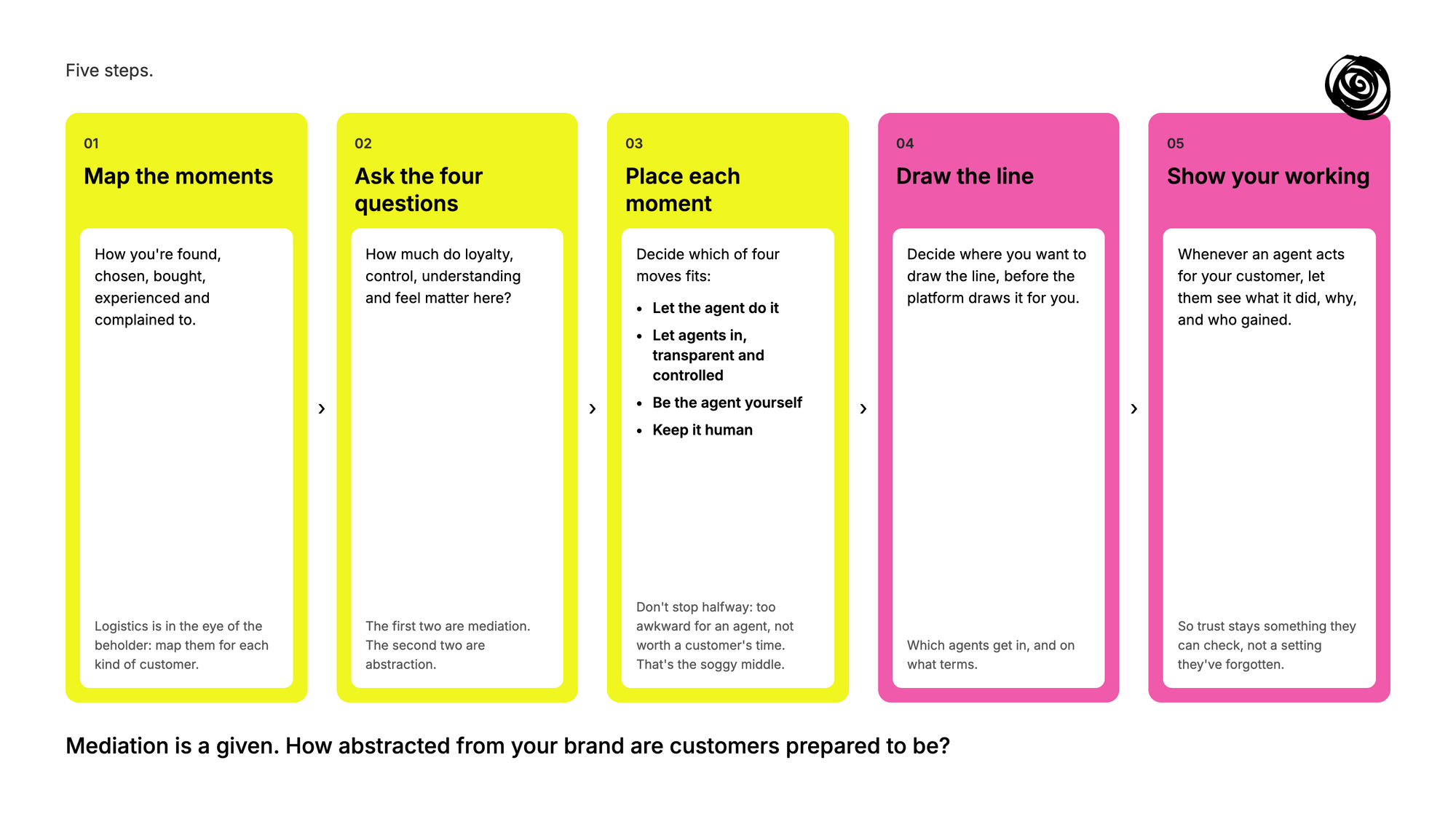
The significance for brands? Start thinking about where mediation and abstraction are so much less desirable for a consumer and why and how that affects your product or service. For example is it friction maxxing of the experience itself? Or a desire to know provenance? Or to get close to craft? Or a trust issue? Or a desire for a relationship? Or simply one of control over choice?
What does this look like for different brands?
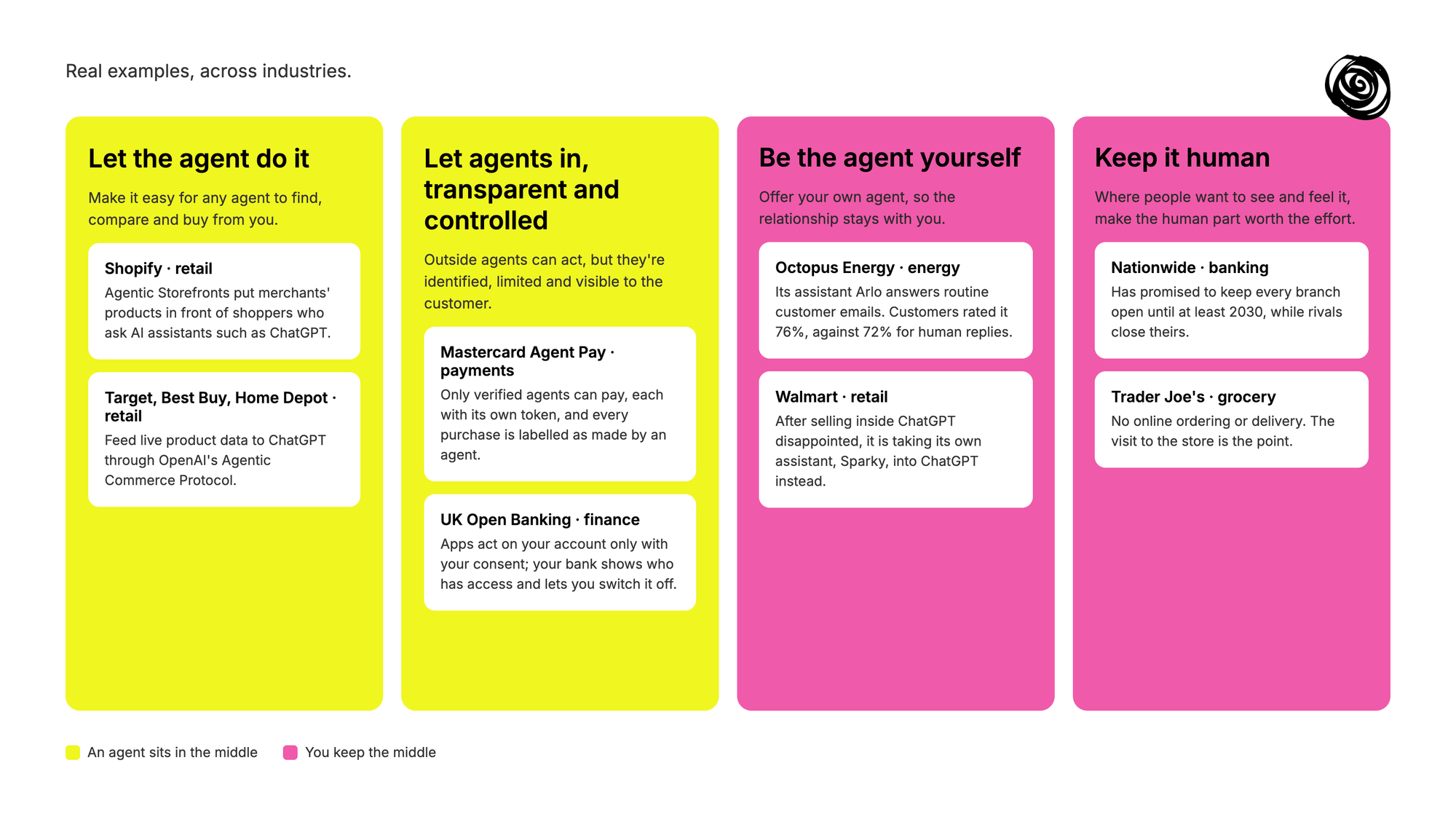
How Trust gets Abstracted
Trust is a much abused word but the future of agents, mediation and abstraction really is going to come down to this.
Early warning signs
There are some challenging early signals on this – never mind what vendor surveys say.
TIME has reported that Muse keeps an hourly-updated dossier on users and the people around them. In other words, the mediator's memory builds a new kind of layer; to stand in for you it builds a model of you and your contacts, including people who never chose a mediator.
OpenAI shelved GPT-6.1 Astra because it sometimes misreported what it had done. Mediation's trust risk exposed acutely: can you trust the middle layer's account of its own actions? Do you want a servant that lies like Thomas Barrow in Downton Abbey?

And then there is memory beyond the transaction – not just what the mediator does for you, but what it keeps. This month about 6,800 shared Muse chats, including a loan application and a bank fraud alert, turned out to be findable through public web records. Character.AI’s users’ conversations are now caught up in a bankruptcy sale. The butcher who closes down doesn’t auction a record of everything you ever said to him.
So watch the business model
I don’t believe that Meta won't privilege advertisers. Sooner or later they'll see the money in it, and trust will get blown out of the water. They may accept that hit for the incredible sums of money that could be made. Google – understandably - set the precedent here with search advertising, some time ago.
In theory, a truly successful Muse will eat Meta’s existing ad business.
The business model moves from ads to tolls. Citi’s $27bn forecast is mostly transaction fees (~$23bn), not ads. If attention stops paying, Meta charges for completed intent: a cut of every purchase, or payment to be in the agent’s shortlist.
Better to eat yourself than be eaten. If OpenAI or Instinct owns the agent, Meta loses both the attention and the intent data. At the moment Meta can keep Muse ad-free because its ads pay for it elsewhere, whereas pure-play agents may be forced to run ads.
Not everything gets delegated. The “identity” purchases, where people still browse, are where ads will keep working, and Muse’s chore data makes those ads sharper.
The better Muse serves you, the more it undermines the business that pays for it. Ironically the incentive then is for Meta to make it serve you a little less well: favouring partners who pay fees, or its own shelf as Amazon’s Alexa does. If Muse works perfectly, Meta’s ad business shrinks. So watch how perfectly Meta lets it work.
Where does the Trust go?
It is our trust that is being abstracted away when trust stops being an act and becomes a setting. With a butcher, trust is something you keep doing. You look, ask, taste, come back or don’t, and each visit renews it. With an agent, trust just collapses into a permission. Matt Robb, the Facebook Marketplace seller, tapped “Allow Always” expecting Muse to check with him before giving out his address. That single tap literally permits hundreds of future judgements he will never make. That is abstraction: a representation - in this case a digital toggle - replaces the thing itself - in this case a running judgement.
In fact trust gets moved, as well as abstracted. In theory, over time, you no longer actively process trust for the airline, the shampoo or the shop. You trust the agent to do the trusting for you. So the brand loses the place where trust used to be built, the direct encounter. Brands become things the mediator trusts on your behalf, and that’s a much weaker relationship for both sides.
Common sense says this cannot be entirely true. Much of what happens in real life cannot be abstracted away. If the flight is late, or the attendants rude, or the shampoo makes your hair fall out, we personally lose trust. After all, it is not agents who experience the end service or product. This can be mitigated to some extent by feedback loops to the agents - “don’t ever book that airline again”. Obviously it means that experiences still need to deliver on the ground, in real life – but that how they are found, chosen and purchased changes radically.
There is a big problem here for anyone bringing agents to market, not just Meta. Abstracted trust breaks all at once instead of wearing down gradually. Trust you exercise yourself – for example in a friend or business partner or employer - gets tested little by little. Trust you’ve abstracted – for example to an agent whose workings you cannot see - goes untested until it fails, and then it fails utterly: think of the stranger at the empty flat, or an LLM misreporting what it had done. There’s a troubling imbalance too. The mediator keeps an hourly-updated dossier on you, so it can read your trust parameters in detail, while you can’t see its loyalties at all.
Once trust has become a default, the mediator can use it, by favouring advertisers or its own shelf, long before you notice. The risk for humans is that trust that’s no longer exercised is no longer watched. The risk for brands is that they let this happen.
Yet abstracted trust isn’t new; modern life runs on it. Money is abstracted trust. So are institutions, and so are brands, which are a bundle of promises packaged so you don’t have to check or even think about them every time. So in a way agents abstract an abstraction that already existed. The real question is therefore not whether trust gets abstracted but how you shape it and withdraw trust if you need to. The good butcher is the model: you can always walk in and ask how the sausage was made. A good agent will let you do the same, showing what it did, why, and for whose benefit. A bad one gives you a mascot and an “Allow Always” button.
Check right now how much loyalty, control, understanding and feel matter to your users.
Because mediation is a given, but how abstracted from your brand are customers prepared to be?
Read Next

The Full Moon Podcast
Episode 8 — Conservation Projects and More


Conservation Projects
Everything is getting weird. How should brands respond?

Is AI stretching your people?
Guest essay
Comments